Organic Search in 2026: The Strategic Guide to Dominating GEO and AI
Organic search in 2026 no longer looks like it did three years ago. Google no longer returns ten blue links: it generates responses, cites sources, interprets intent before you have even finished typing. The rules have changed, but the challenge remains the same — being visible at the right moment, for the right people.
For B2B directors and marketing managers, this shift is a genuine opportunity. Companies that understand the logic of answer engines and generative AI today will build an advantage that is difficult to close. Those who wait will suffer the consequences.
This guide gives you the keys to adapting your approach, generating qualified leads and building organic visibility that lasts, with the support of a team that has been doing this for over ten years.
Key Takeaways:
- Classic SEO is evolving towards GEO (Generative Engine Optimization): being cited by AI is the new first place.
- Google’s AI Overviews reduce clicks on informational queries, but amplify the brand awareness of recognised names.
- E-E-A-T (Experience, Expertise, Authority, Trustworthiness) is becoming the central criterion by which AIs select sources.
- Content must respond to conversational intent, not simply align keywords.
- SEO and paid advertising (Google Ads, Meta Ads) must work in synergy to maximise ROI.
- The KPIs to track are no longer clicks, but conversions and qualified leads.
The Deep Transformation of SEO: Beyond the “10 Blue Links”
The search engine you knew no longer really exists. In 2026, Google, Bing and their equivalents have become answer engines. They synthesise, reformulate and generate content from your pages, often without the user needing to click on anything at all.
Credible brands, reliable content and technically solid sites are the first sources cited by AIs. This is not a coincidence: it is exactly what Google has been trying to measure for years. AI has simply made this filter much more visible.
This paradigm shift demands a clear strategic response. It is no longer about chasing the algorithm, but about building a digital presence that the algorithm cannot ignore.
Understanding the Transition from SEO to GEO (Generative Engine Optimization)
GEO — Generative Engine Optimization: A discipline that consists of optimising content no longer to obtain a ranking in traditional search results, but to be selected and cited as a trusted source by AI-based answer engines (Google SGE/AI Overviews, Perplexity, Bing Copilot, ChatGPT Search).
GEO extends SEO without replacing it. Whereas classic organic search aimed to place a URL on the first page, GEO seeks to make your content the reference that AI uses to formulate its responses. The selection criteria are different: clarity of the response, reliability of the source, richness of structured data.
In concrete terms, an effective GEO strategy rests on three pillars. Content structuring so that AI can extract and understand it easily — FAQ, definitions, lists, tables. Brand credibility via E-E-A-T signals. And the semantic consistency of the entire site, which shows algorithms that your expertise is deep and coherent.
These three pillars are not new. What is new is how decisive they are becoming. A page well-ranked in 2023 can become invisible in 2026 if it is not designed to be understood and cited by AIs.
The transition to GEO also means thinking of content as a direct response, not as a classic blog article. The formats that work best in AI Overviews are those that define, compare, list and explain — not those that tell stories. Storytelling retains its place in brand strategy, but the technical side demands a different logic.
The Impact of AI Overviews on Organic Traffic: Threat or Opportunity?
Google’s AI Overviews (formerly SGE) have indeed reduced the click-through rate on certain informational queries. Studies conducted in 2025 show CTR drops of 15 to 30% on “what is” or “how to” type queries. This is real. But this figure masks a more nuanced reality.
Queries with strong commercial intent — those that generate leads — remain largely unaffected. A user searching for “SEO agency Lyon SME” or “B2B organic search support” is in a decision phase: they click, compare, contact. AI does not stop them, it simply eliminates the poorly-positioned competitors ahead of them.
Being cited in an AI Overview also strengthens brand awareness in a way that classic SEO could not. Users who see your name as a trusted source remember your positioning, even without clicking. This is a long-term organic visibility asset that less well-structured competitors simply cannot buy.
Note: B2B brands that invested in their authority and E-E-A-T before the rollout of AI Overviews generated up to 40% additional referral traffic via AI citations, according to internal analyses from several Google Partner agencies. The first-mover advantage is real here.
E-E-A-T and Social Proof: Your Most Valuable Asset
Google has codified its quality criteria in what it calls E-E-A-T: Experience, Expertise, Authority, Trustworthiness. In 2026, these signals no longer simply serve to evaluate your individual pages. They determine whether your brand deserves to be cited by AIs — and how frequently.
The digital credibility of your business has become a strategic infrastructure, on a par with your website itself. Ignoring this aspect is building on sand.
Why Brand Authority is Superseding Traditional Backlinks
For years, organic search was a game of backlinks. Quantity, anchors, referring domains: SEO teams timed every acquisition. This model is not dead, but it has lost its primacy.
In 2026, Google’s algorithms and AI models evaluate brand authority holistically: press mentions, authentic customer reviews, consistent presence on social media, citations from sector experts, participation in professional events. A backlink from a quality site still carries weight. But a brand that exists only in its inbound links remains fragile, and the algorithms know it.
Strong E-E-A-T signals combine proof of real experience (case studies, measured client results), visible expertise (identified authors, biographies, certifications) and editorial reliability (cited sources, update dates, transparent corrections). This is not a checklist — it is a coherent whole that is built over time.
A B2B director who invests in an expertise content strategy — interviews, sector case studies, signed practical guides — builds a trust capital that backlinks alone cannot replicate. Brand authority is earned, not bought in bulk.
How Doko Helps Build Lasting Digital Credibility
At Doko, we work on brand authority as a continuous project, not a one-off campaign. Our approach begins with an initial credibility audit, then an editorial plan focused on professional expertise, and the activation of trust signals across all channels.
In practice, this involves creating detailed author pages, optimising Google Business Profile listings, implementing structured client review strategies, and producing reference content that sector publications want to cite.
Our B2B clients generally see a notable improvement in their visibility in AI Overviews between 4 and 8 months after starting the E-E-A-T project. This is not magic: it is method.
“Since working on our expert positioning with Doko, we are cited in Google’s AI responses on our priority queries. Our qualified traffic has increased by 38% in 6 months.” — Marketing Manager, Lyon-based B2B industrial company
Content Strategy 2026: From Keyword to Conversational Intent
Producing content for organic search in 2026 no longer means writing 800 words around a keyword and hoping it ranks. Algorithms understand language, detect quality, and reward content that genuinely responds to users’ needs.
The good news: this requirement benefits brands that have something to say. Generic content factories are the first losers.
“User-First” Content: Responding to Needs Before Algorithms
The “User-First” approach starts from a simple question: what does my reader really want to understand, solve or decide? The answer to this question guides the structure, tone and depth of the content — not the other way around.
Google measures precise behavioural signals: time spent on the page, bounce rate, return to search results. Content that does not satisfy the user’s actual intent will be penalised, even if it is technically optimised. Content that responds precisely and quickly will be rewarded, even on a lower-authority site. This is both fair and harder than it appears.
Predictive content marketing takes the logic further: it anticipates the questions users will ask in six months, based on emerging search trends and developments in sector news. This is where serious strategic monitoring and an experienced editorial team make the difference between those who follow and those who lead.
For a B2B marketing manager, this translates into an editorial calendar built around your clients’ decision cycles, not raw search volumes. An article that answers the question your prospect asks during the qualification phase is worth ten generic articles written for volume.
The End of Keyword Stuffing: The Era of Contextual Semantic Clusters
Semantic SEO has replaced keyword density logic for several years now. In 2026, it is the organisation into contextual semantic clusters that prevails: a pillar page covers a subject in depth, satellite pages enrich it from complementary angles, and the whole forms a coherent network that algorithms reward.
This architecture responds to two imperatives: covering all the search intents related to your expertise, and showing Google (and AIs) that your site is the most complete resource in your field. Not the most voluminous. The most complete.
- Identify the pillar topics of your sector, those on which your expertise is most legitimate.
- Map secondary intents: frequently asked questions, comparisons, practical guides, use cases.
- Create satellite pages that address each sub-topic with precision and depth.
- Structured internal linking: connect pages to one another in a logical and contextual way.
- Regular updates of pillar content to maintain their authority over time.
A well-built cluster is not just a content organisation — it is a clear signal sent to AIs: “on this subject, we are the reference.” Brands that structured their content in clusters before 2025 are dominating the generated responses in their sector today. The gap can be closed, but every month counts.
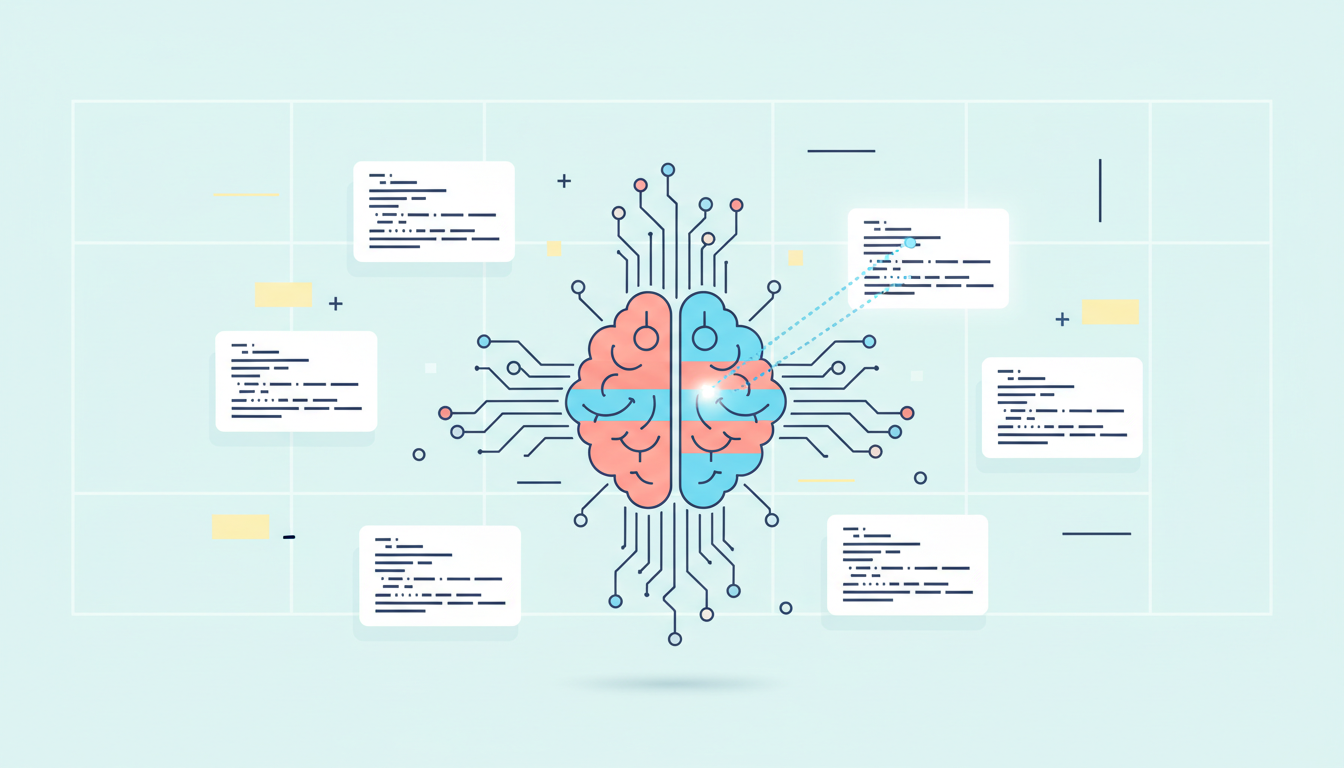
Audit, semantic structuring and ongoing optimization. We put in place an SEO strategy built for answer engines to attract more qualified clients
Beyond SEO: Omnichannel to Maximise Your ROI
Organic search in 2026 is a pillar of your digital acquisition. But it no longer acts alone. B2B purchasing journeys have become complex: a decision-maker sees your brand on LinkedIn, searches for you on Google, clicks on an ad, reads a blog article, then fills in a form. Every channel contributes to the final decision. None is sufficient on its own.
SEO / Google Ads Synergy: The Hybrid Approach to Capture Visibility
| Criterion | SEO alone | Google Ads alone | Hybrid approach (recommended) |
|---|---|---|---|
| Results timeline | 3 to 6 months minimum | Immediate | Immediate (Ads) + lasting (SEO) |
| Long-term cost | Low (amortised investment) | High (permanent cost per click) | Optimised: SEO reduces Ads cost |
| Priority query coverage | Partial (indexing delay) | Total but costly | Total and progressive |
| Available data | Limited post-iOS tracking | Rich (conversions, costs) | Cross-referencing of both sources |
| Calculable SEO ROI | Difficult to isolate | Direct | Multi-touch attribution model |
The synergy between SEO and Google Ads rests on a clear logic: advertising data reveals which queries actually convert. These insights feed the SEO editorial strategy. In return, SEO reduces dependence on paid clicks for informational queries. One reinforces the other, and budgets are better used as a result.
Doko, Google Premier Partner, has been steering this hybrid approach for its clients for over 10 years. The advantage of working with a team that manages both SEO and Google Ads campaigns: the two strategies talk to each other, decisions are based on all the available data, and there is no loss of coherence between two suppliers who never communicate.
In practice, we consistently observe among our clients that the queries identified as most profitable in Ads become the priority subjects of the SEO editorial plan. The result: after 6 to 12 months, the total acquisition cost falls because SEO takes over a portion of the traffic that Ads was paying for alone.
Why SEO Alone is No Longer Enough to Convert (The Contribution of Meta Ads)
A user who discovers your brand via a Google search is not necessarily ready to contact you the same day. In B2B, the decision cycle can last several weeks, sometimes several months. If you disappear from their field of vision between their first search and their final decision, you lose the lead to a more present competitor.
Meta Ads (Facebook and Instagram) allow you to retarget organic visitors to your site with personalised messages based on their level of engagement. This is the missing link between SEO discovery and conversion.
Effective B2B lead acquisition in 2026 therefore combines SEO to generate discovery, Google Ads to cover high-commercial-intent queries, and Meta Ads to accompany the prospect through their maturation phase. Three channels, one coherent strategy. The difficulty is not choosing between them — it is making them work together.
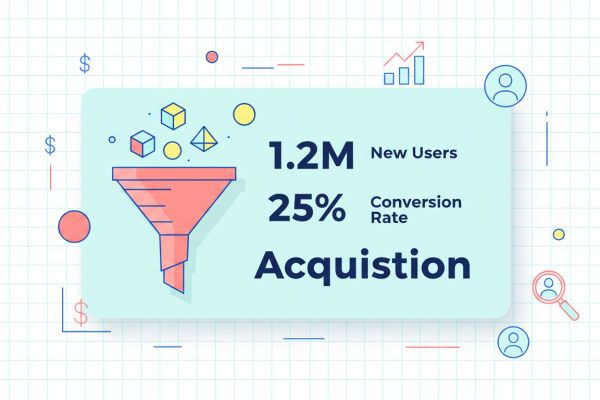
B2B companies that align these three channels under a single content strategy generally observe a lead-to-client conversion rate 25 to 35% higher than those who manage them in silos. This is the difference between a generalist agency and a partner who thinks about your acquisition as a whole.
How to Audit and Adapt Your SEO Strategy in 2026
Before investing in an organic search strategy, you need to know where you stand. A rigorous audit reveals quick wins, priority projects and technical blockers that are holding back your organic visibility without your knowledge.
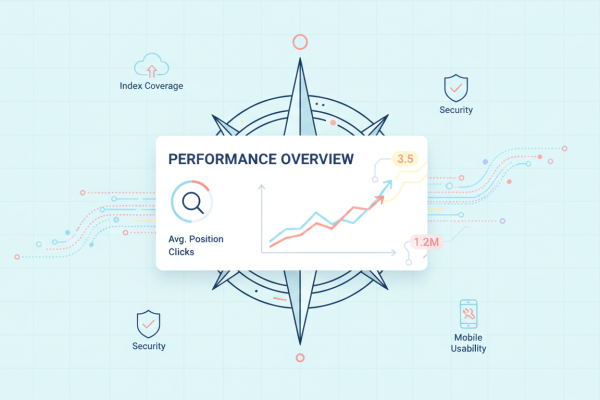
A good SEO audit in 2026 is no longer limited to positions and backlinks. It integrates the analysis of AI Overviews presence, thematic cluster semantic coverage, and UX performance measured by Core Web Vitals. These three additional dimensions are what allow you to understand why a technically sound site is stagnating despite its efforts.
Analysing Performance Signals: Which KPIs to Track?
Traditional SEO metrics — average positions, total organic traffic volume — remain useful, but no longer tell the whole story. In 2026, the dashboard of a sustainable acquisition strategy must include:
- Qualified organic traffic: sessions from commercial-intent queries, not just informational ones.
- Conversion rate by source: what proportion of SEO traffic generates contact requests, quotes, calls.
- Citations in AI Overviews: presence and frequency of your pages as sources in AI responses.
- Semantic Share of Voice: coverage of your thematic cluster relative to competitors.
- Core Web Vitals: LCP, INP, CLS — 2026 web performance indicators directly linked to user experience.
SEO ROI is now calculated all the way back to the revenue generated, not stopping at clicks. This is a calculation that Doko systematically carries out with its clients, through monthly business-oriented reporting — not position tables that give the illusion of progress.
A director who receives a monthly report showing the evolution of the number of qualified leads attributed to SEO, and their acquisition cost compared to Ads, makes very different investment decisions. This is precisely the level of clarity we aim for in our projects.
The Role of UX and Core Web Vitals in the Generative User Experience
Core Web Vitals are not merely technical metrics. They measure the actual quality of the experience you offer to your visitors: display speed, visual stability, responsiveness to interactions. In 2026, these signals directly influence the likelihood that an AI will recommend your page over another.
A slow or visually unstable site generates rapid bounces. These bounces send a negative signal to the algorithms. Conversely, a fluid site, readable on mobile, that loads in under 2.5 seconds, reinforces all your other quality signals. This is the kind of detail that seems secondary — until you compare your positions with those of a competitor.
AI optimisation also requires clean HTML structure: correct semantic tags, complete Schema.org structured data, clear markup of content sections. This is what allows the crawlers of answer engines to understand, extract and cite your content with precision.
Keyword analysis remains fundamental, but must extend to the analysis of conversational intents: how users phrase their questions to ChatGPT or Gemini, what responses are expected, what types of content are highlighted in generated responses. This gap between a textual query and a question asked to an AI is often where the opportunities lie.
The combination of UX + technical structure + E-E-A-T signals forms the foundation of a site that AIs want to cite. None of the three is sufficient alone. Together, they create a digital presence that withstands algorithmic changes and generates value over the long term.
FAQ: Your Questions About Organic Search in 2026
What is GEO and how does it differ from classic SEO?
GEO (Generative Engine Optimization) focuses on optimisation for AI-generated responses, whereas SEO targets link rankings. In practice, it means making your content the source that engines such as Google AI Overview, Perplexity or ChatGPT Search cite when they answer your potential clients’ questions. The logic is different: it is no longer about being in position 1, but about being the reference.
Is organic search dead in 2026?
No, it is mutating. The goal is no longer to rank a page, but to become the AI’s trusted source. Organic traffic is evolving in form and quality: fewer clicks on basic informational queries, but more qualified traffic on commercial-intent queries. Companies that adapt their strategy now are securing their digital acquisition for the years ahead.
What role does E-E-A-T play in AI searches?
AI favours reliable and recognised sources in order to avoid hallucinations. E-E-A-T (Experience, Expertise, Authority, Trustworthiness) is the filter that AI models use to decide which sources deserve to be cited. A brand with strong digital credibility, identified authors and proof of real expertise will systematically be preferred over anonymous content, even if the latter is technically well-positioned.
How do you measure SEO ROI when traffic is falling?
By tracking actual conversions and qualified leads rather than click volume. A drop in raw traffic can mask an improvement in visitor quality. A site receiving 30% fewer visits but generating 20% more contact requests is performing better than before. Tracking SEO ROI means attributing revenue to organic sources, via precise analytical reporting.
SEO and Ads: should they be worked on together?
To maintain a presence on high-conversion queries, yes. SEO alone cannot immediately cover all priority queries, and Ads alone are too expensive in the long term. The most effective B2B acquisition strategy in 2026 articulates both channels: SEO for lasting visibility, Ads for immediate coverage of high-commercial-stakes queries. Working with an agency that masters both, like Doko, avoids the coherence losses that arise when two separate suppliers never communicate.
Want to know where your organic search strategy stands? The Doko team offers an initial SEO audit to identify your priorities and define a results-oriented action plan. Contact us from Lyon or remotely.