Will Predictive AI Replace Manual A/B Tests in 2026?
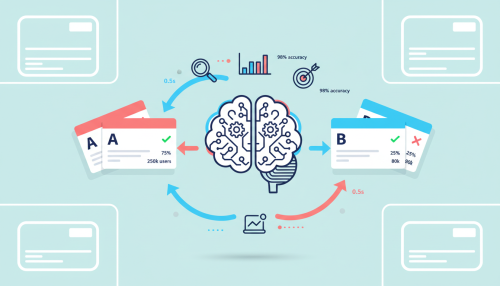
Waiting three weeks to find out which version of a page converts best, testing one variable at a time, accumulating inconclusive dashboards: the classic A/B test is showing its limits against the pace of today’s web. This is precisely where Predictive AI comes onto the scene, with a compelling promise: predicting the result of a test before even launching it.
Enough to imagine the end of manual tests? The honest answer is more nuanced. Predictive AI profoundly transforms the way of testing, but it does not eliminate the need to validate. Confusing a prediction with proof is even the most costly mistake one can make in optimisation.
Here is what predictive AI really delivers, where it fails, and how to use it without making mistakes.
Key takeaways from this article
- Predictive AI estimates the probable result of a variant from historical data, before any test.
- It accelerates prioritisation and saves considerable time on low-potential hypotheses.
- A prediction remains a probability, not a certainty: it does not replace real validation.
- Models lose reliability on new brands, expensive products or original creatives.
- The winning combination in 2026 pairs prediction for filtering and testing for confirmation.
What is Predictive AI Applied to Testing?
Predictive analysis consists of using machine learning models to anticipate a future result from past data. Applied to optimisation, it assigns a probable performance score to a variant — a headline, a button, a layout — calculated from thousands of similar historical cases.
Definition: predictive analysis
Predictive analysis encompasses the statistical and machine learning techniques that estimate the probability of a future event from historical data. Regression, decision trees, neural networks or gradient models: the algorithm learns the links between the characteristics of content and its past performance, then projects them onto new content.
In practice, instead of publishing two versions and waiting weeks, you submit your variants to a model that indicates, within a few seconds, which one has the best chance of working. The logic shifts from reactive to predictive.
What Predictive AI Really Changes
The contributions are real and documented. They focus on three uses where AI excels without controversy.
- Hypothesis prioritisation: AI analyses your visitors’ behaviour, identifies friction points and ranks your test ideas by estimated impact. You stop testing at random.
- Creative filtering: each variant receives a score before delivery. The less promising ones are eliminated before consuming budget or traffic.
- Dynamic traffic allocation: so-called multi-armed bandit algorithms automatically send more traffic to the winning variant during the test, reducing the cost of losing versions.
The speed gain is spectacular. Whereas a manual test takes two to four weeks, an AI-assisted cycle reaches significance much faster, and allows testing dozens of micro-variants in parallel. For teams producing a hundred creatives per week, testing each one in real conditions would simply be impossible.
Manual A/B Test and Predictive AI
|
Criterion |
Manual A/B test |
Predictive AI |
|---|---|---|
|
Nature of result |
A measured proof |
An estimated probability |
|
Timeline |
2 to 4 weeks |
A few seconds to a few days |
|
Testable volume |
1 to 2 variables |
Dozens of variants |
|
Reliability |
High if well conducted |
Variable depending on data |
|
Ideal role |
Confirming a winner |
Filtering and prioritising upstream |
Audit, conversion rate optimization and rigorous testing. We combine predictive AI and method to improve your performance without taking risks.
Why Predictive AI Does Not Replace Testing
This is the heart of the matter, and the nuance that commercial pitches often gloss over. A prediction is not a measurement. It indicates what has a good chance of working, not what actually works on your audience, today.
The Training Data Problem
A model is only as good as the data it has learnt from. If you are a new brand with little history, its personalised predictions will be unreliable in the first weeks. The 2026 benchmarks are clear on one point: AI reaches parity with human creative work on low-price products, but remains behind on expensive, emotionally complex or culturally nuanced products.
The Black Box Effect
Many tools return a score without explaining why one variant scores 7.3 and another 5.8. The model knows, the team does not. Iteration then becomes guesswork. This opacity slows adoption and, in regulated sectors, an inexplicable decision poses a real compliance problem.
The Risk of False Certainty
The most concrete danger: acting on a prediction as if it were a result. A model can favour the immediate click at the expense of long-term value, or generate off-brand variants. Without human validation and without a confirmation test on high-stakes hypotheses, you are optimising confidently in the wrong direction.
The Right Approach: Predict to Filter, Test to Confirm
The model that is establishing itself in 2026 does not pit the two methods against each other, it chains them together. Prediction serves as an upstream sorting layer, the A/B test as a downstream proof layer.
In practice: every new creative passes through the predictive score, which eliminates the least promising ones before any spend. The best ones go into a real test, where only statistical significance decides. It is this discipline, not the software, that makes the difference. A study of 347 e-commerce shops showed that expert-driven tests delivered 28 to 34% conversion gains, versus 4 to 7% for fully autonomous AI tools. The gap comes not from the tool, but from the presence of a practitioner who frames, interprets and waits for true statistical confidence before acting.
Another essential safeguard: governance. Analysts anticipate that the majority of fully autonomous AI projects will never reach their full value, for lack of control. No sensitive modification — a price, a delivery promise — should be deployed without human validation.
Doko, Your Optimisation and Data Partner in Lyon
Doko is a human-scale Lyon-based webmarketing agency, based in La Mulatière. A Google Premier Partner, we help businesses improve their conversion rates by combining the right tools and a rigorous method, from technical SEO to behavioural analysis.
Our position on predictive AI is simple: it is a formidable accelerator, provided you never confuse prediction with proof. We use it to prioritise and filter, and we validate what matters through real tests. We work on real data, without promising miracles. Want to optimise your site without wasting your traffic? Request a quote.
FAQ: Predictive AI and A/B Tests
Does Predictive AI Make A/B Tests Useless?
No. It estimates a probable result, but only a real test measures performance on your audience. The best practice is to predict to filter ideas, then test to confirm the most promising ones.
What is the Difference Between Prediction and A/B Testing?
An A/B test is a measurement: you pit two versions against real traffic and observe which one wins. A prediction is an estimate calculated from past data. One proves, the other anticipates.
Is Predictive AI Suitable for a Small Business?
With caution. Models improve as they accumulate data specific to your site. A young organisation with little history will obtain less reliable predictions at first, and will need to rely more heavily on real tests.
What are the Risks of Relying Solely on Prediction?
Optimising confidently in the wrong direction, favouring the immediate click at the expense of lasting value, or serving off-brand variants. Without human validation or a confirmation test, false certainty is expensive.
Do You Need a Data Scientist to Use Predictive AI?
Not necessarily, as the tools have become democratised. However, a practitioner who frames the hypotheses, interprets the scores and enforces statistical rigour remains the decisive success factor, far more so than the software itself.