🥊 SearchGPT vs Google Search: The Duel That Will Redefine the Web in 2026?
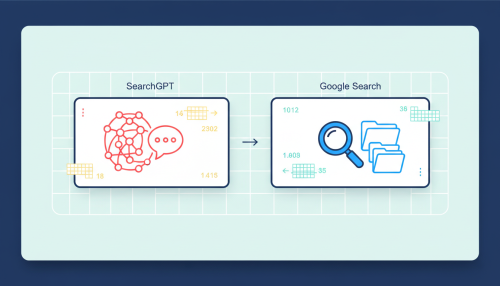
Google still holds 91.1% of the global market for search in August 2026, according to StatCounter. At the same time, approximately 60% of searches carried out in the United States no longer generate any click to a third-party site. That is the entire challenge of the SearchGPT vs Google Search duel: market share dominance no longer says much about the real traffic generated.
SearchGPT was a search prototype launched by OpenAI in July 2024, tested in limited access. It joined ChatGPT under the name ChatGPT Search, deployed between October and December 2024 and expanded throughout 2025. The name “SearchGPT” remains widely searched by the public: we keep it here, even though the product is now called ChatGPT Search.
Key takeaways
- Google retains 91.1% of the search market (StatCounter, August 2026), well ahead of Bing (4.5%).
- No reliable market share figure exists for ChatGPT Search, despite 900 million active users per week in February 2026.
- Both sides now monetise through advertising: OpenAI’s programme active since March 2026, already $1 billion in revenue by August 2026.
- Google fights back with AI Overviews (worldwide since October 2024) and AI Mode, powered by Gemini, since March 2025.
- Verdict at this stage: tense cohabitation rather than replacement, under regulatory pressure on both sides.
🤖 What Is SearchGPT and How Is It Disrupting Information Search?
Visual suggestion: ChatGPT Search vs a classic Google SERP. Alt: comparison of ChatGPT Search and Google Search interfaces.
Definition: ChatGPT Search. A web search feature integrated into ChatGPT, inherited from the SearchGPT prototype launched by OpenAI in July 2024. It allows ChatGPT to query the web to produce precise, up-to-date answers.
Companies can influence how their content appears in ChatGPT Search results, through a mechanism distinct from Google’s. OpenAI is not stopping at the search bar: in October 2025, the company launched ChatGPT Atlas, a browser with an agentic mode capable of acting directly on behalf of the user.
💬 OpenAI’s Conversational Approach vs Traditional Queries
Where a Google query remains a chain of keywords, ChatGPT Search works through multi-turn exchanges: the user refines their request throughout the conversation, without starting from scratch each time.
You no longer ask for a list of pages — you present a problem to solve.
📑 User Experience: Goodbye to Classic Results Pages (SERPs)?
ChatGPT Search offers a single synthesised response, where Google still displays a list of organic links supplemented by an AI block at the top of the page. The instinct to browse ten blue results mechanically recedes when faced with a direct answer.
No reliable comparative data exists on the speed or mobile ergonomics of the two interfaces.
Doko’s view: we observe with our clients that the question is no longer “being on the first page” mais “being the source cited in the response“. Deux objectifs, deux méthodes de travail.
🛡️ Google Search in 2026: The Giant’s Response to Generative AI
Faced with ChatGPT Search, Google did not wait: the Mountain View firm deployed its own generative layer within its historic search engine.
✨ The Massive Integration of Google Gemini and AI Overviews
AI Overviews replaced the former name “SGE” at Google I/O in May 2024, with a global rollout from 28 October 2024. Since May 2025, the feature covers more than 200 countries and territories, in 40 languages.
In March 2025, AI Mode was added, designed for complex multi-part queries and powered by Gemini, initially reserved for Google One AI Premium subscribers in the United States.
🏰 The Google Ecosystem: A Competitive Advantage That Is Hard to Dethrone
Android, Chrome, Workspace, the advertising platform: Google relies on a distribution ecosystem that no competitor replicates at this scale. This partly explains its 91.1% market share despite the rise of ChatGPT Search.
Doko’s view: our experience shows that this dominant position remains Google’s number-one asset for absorbing the impact of generative AI, far more than the raw quality of responses.
⚖️ Direct Comparison: SearchGPT vs Google Search
Three elements make the real difference between SearchGPT (ChatGPT Search) and Google Search in 2026:
- The logic of information access: single conversational response vs results page enhanced with an AI block.
- The business model: two engines now monetised through advertising, but at very different scales.
- The relationship with sources: distinct citation mechanisms and unequally documented.
| Criterion | SearchGPT (ChatGPT Search) | Google Search |
|---|---|---|
| Origin | OpenAI prototype, July 2024 | Historic search engine, AI added since 2024 |
| Response format | Conversation, synthesised response | SERP + AI Overviews / AI Mode |
| Search market share | Not measured by StatCounter | 91.1% (StatCounter, August 2026) |
| Active users | 900M weekly (Feb. 2026) | Billions, via the Google ecosystem |
| Monetisation | Ads since March 2026, $1bn (August 2026) | Historically dominant advertising |
| Cited sources | Poorly documented mechanism | Primarily Quora, then Reddit (2025 study) |
SearchGPT vs Google Search: two ways to search the web in 2026.
Conversational search, AI-generated answers, SERP visibility and citations: discover the differences between ChatGPT Search and Google and adapt your SEO and GEO strategy.
🎯 Relevance and Accuracy of Responses
Google had to temporarily restrict AI Overviews in May 2024, after absurd and dangerous suggestions went viral, such as eating rocks or adding glue to a pizza. Other documented hallucinations concern Tropicana juice or names of African countries.
No equivalent hallucination case and documented has been found for ChatGPT Search in available sources: this is not proof of superior reliability, merely the absence of a case that received as much media coverage.
💰 Advertising, Monetisation and the Relationship with Sources
The “David vs Goliath without ads” narrative no longer holds. OpenAI announced on 17 January 2026 an advertising programme for free, connected and adult users in the United States, active from March 2026. Result: $1 billion in advertising revenue for ChatGPT by August 2026, an amount intended to finance the $1.4 trillion in infrastructure investment committed by OpenAI over eight years.
Note: comparing the “market shares” of the two players remains structurally biased. Google has a precise StatCounter figure (91.1%), ChatGPT Search has no equivalent.
On the sourcing side, AI Overviews most often cites Quora, then Reddit, according to a June 2025 study. ChatGPT Search follows a different logic: brands can influence their appearance in responses, through a less publicly documented mechanism.
📱 Speed, Ergonomics and Mobile Accessibility
On mobile, a conversational interface requires fewer navigation gestures than a classic results page, by design. But no reliable quantitative data allows a definitive verdict on which is objectively faster or more accessible.
Doko’s view: we recommend our clients test their own pages on both environments rather than relying on general impressions. The gap often plays out on a case-by-case basis.
🔮 Will SearchGPT Really Kill Google Search? The Verdict for 2026
Nilay Patel, editor-in-chief of The Verge, coined the term “Google Zero” to describe the point where Google would no longer generate any clicks to publishers. Katie Drummond of Wired speaks of “traffic apocalypse“. Two striking terms, to be put in context where Google remains overwhelmingly dominant in market share.
⚠️ The Current Limitations of Generative AI (Hallucinations, Energy Cost)
The documented hallucinations at Google in May 2024 are a reminder that generative search remains fallible, even at the market leader. The energy cost of generative AI is another widely acknowledged limitation of the sector, even though no precise and verified figure allows it to be quantified here.
🤝 Towards Cohabitation or a Shared Monopoly?
The SearchGPT vs Google Search battle is also playing out before regulators. In August 2024, a US federal court ruled that Google held an illegal monopoly over search and search-related advertising. In December 2025, the European Commission opened an investigation specifically targeting AI Overviews for possible violation of competition law.
Google is therefore strengthening its AI position while remaining under legal scrutiny on both sides of the Atlantic. It is not going to disappear in 2026, and ChatGPT Search is not going to replace it either: the most likely scenario remains a tense cohabitation, arbitrated as much by regulators as by usage patterns.
Doko’s view: on the Doko side, we do not recommend betting on one side. Our clients track both channels in parallel, measure where their qualified traffic genuinely lands, and adjust their budget on those figures rather than on announcement effects.
If your traffic depends on visibility in classic results as well as AI responses, Doko supports businesses on their SEO strategy and their visibility in generative engines (GEO), with an audit tailored to your sector.
❓ FAQ: Everything You Need to Know About the SearchGPT vs Google Search Impact
🧩 What Exactly Is SearchGPT?
SearchGPT was a web search prototype launched by OpenAI in July 2024. It has since joined ChatGPT under the name ChatGPT Search, deployed between October and December 2024.
🌍 Is SearchGPT (ChatGPT Search) Available to Everyone?
Yes, the feature expanded throughout 2025. ChatGPT claims 900 million weekly active users in February 2026, and Google’s AI Overviews covers more than 200 countries since May 2025.
📉 Will Google Search Disappear?
Nothing in the available figures points in that direction. Google retains 91.1% of the global market in August 2026, even as it faces 60% zero-click searches and two separate regulatory investigations.
🔀 What Are the Major Differences Between SearchGPT and Google Search?
A multi-turn conversational response vs a results page supplemented by AI, different sourcing (Quora and Reddit dominate at Google), and two advertising models now active but at very different scales.
✍️ What Is the Impact on SEO and Content Creators?
Google stated it officially in 2026 in its documentation: “optimizing for generative AI search is optimizing for the search experience, and thus still SEO.” Zero-click (60% of US searches) remains the real economic risk for publishers, more so than the disappearance of SEO itself.
In 2026, the SearchGPT vs Google Search duel therefore has no clear winner. Usage patterns are being redistributed, and the consequences for those who depend on organic traffic are very real.
📚 Sources
Source: https://gs.statcounter.com/search-engine-market-share
Source: https://en.wikipedia.org/wiki/ChatGPT
Source: https://en.wikipedia.org/wiki/Zero-click_result
Source: https://en.wikipedia.org/wiki/AI_Overviews
Source: https://en.wikipedia.org/wiki/Google_Search
Source: https://en.wikipedia.org/wiki/Generative_engine_optimization