What is Agentic SEO? Definition, Stakes and AI Strategy
“We are no longer creating content for Google to display, but for AI agents to choose and recommend.” This sentence from Pauline Rocher summarises the ongoing break in organic search better than any definition could.
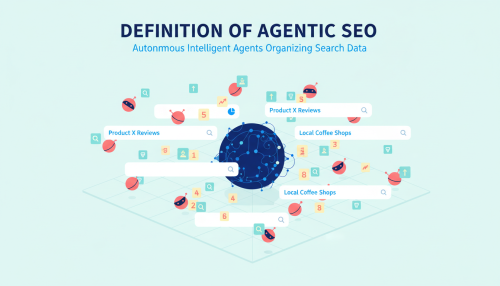
Agentic SEO is not a conference buzzword. It is the name given to a structural transformation of search: autonomous artificial intelligence systems that navigate the web, analyse sources and decide — without human intervention — which content deserves to be cited, recommended or synthesised in a response.
For businesses, the stakes are immediate. Is your website structured to be understood and selected by these agents? Or will it simply disappear from tomorrow’s results?
- Agentic SEO refers to all the optimisation techniques targeting search systems based on autonomous AI agents.
- These agents follow a “Perceive, Reason, Act” cycle that is radically different from classic Google crawling.
- Optimisation for generative search engines (GEO) rests on three pillars: conversational authority, truth fragments and API connectivity.
- Implementing an agentic strategy is done in three steps: task automation, data structuring, semantic workflows.
- “Human-in-the-loop” is not a limitation — it is the quality guarantee that automation alone cannot offer.
Understanding Agentic SEO: Definition and How It Works
What is an Autonomous AI Agent?
An AI agent is not a simple chatbot. According to Google in its whitepaper “Agents” published in September 2024:
Anthropic, for its part, defines an agentic system as “an application where an AI (most often an LLM) interacts with tools to accomplish a task.”
The difference from a classic AI workflow is fundamental. A workflow is predefined: the AI follows a fixed script, step by step. An autonomous agent, on the other hand, uses an LLM to dynamically direct its own actions based on context. It can change strategy mid-course, call external tools, self-correct and loop until it reaches its objective.
It is this decisional autonomy that changes everything for SEO. A ranking algorithm can be anticipated. An agent that reasons, compares and decides in real time is another matter entirely.
The “Perceive, Reason, Act” Cycle Applied to Search
Perplexity, Google AI Overviews, AI assistants integrated into search engines: all operate according to the same fundamental cycle.
Perceive: the agent collects information from its environment — the content of your website, your structured data, your exposed APIs and the available authority signals.
Reason: the LLM analyses, compares and evaluates the relevance and reliability of sources. This is where selection takes place: is your content sufficiently structured and factual to pass the filter?
Act: the agent produces a response, synthesises information or triggers an action. If your source has been retained, it is cited or summarised. If not, you are absent from the response.
This cycle can repeat several times to refine the result. An agent looking for an answer about local SEO in Lyon will not simply index a page — it will compare several sources, evaluate their coherence and retain the most structured and complete one. This is no longer a question of keywords. It is a question of clarity and trust.
Traditional SEO vs Automated SEO vs Agentic SEO
These three approaches are distinguished by their level of autonomy and their optimisation logic.
| Approach | Logic | Role of AI | Final objective |
|---|---|---|---|
| Traditional SEO | Optimise for link-based ranking algorithms | None or analysis tool | Ranking in classic SERPs |
| Automated SEO | Execute SEO tasks via scripts and tools | Assistance, content generation | Gain operational efficiency |
| Agentic SEO | Optimise to be selected by autonomous AI agents | Decision-making agent, orchestrator | Visibility in AI responses (GEO) |
Agentic SEO does not replace the previous two, it layers on top of them. A technically deficient site will not be better treated by an AI agent. But a technically solid site that does not speak the “language” of LLMs will be invisible in generative responses. Both fronts are open simultaneously.
Why is Agentic AI Revolutionising Organic Search?
The Evolution Towards Generative Search Engines (SGE / GEO)
GEO — Generative Engine Optimization — refers to optimisation for generative search engines. Google AI Overviews, Perplexity, ChatGPT Search and Gemini no longer return a list of links. They synthesise a response directly, citing the sources deemed most relevant.
The trajectory is clear: classic SEO → SXO (Search Experience Optimization) → AIO (AI Optimization). Each transition has reduced the share of “classic” organic traffic in favour of a recommendation-by-synthesis logic.
In this context, agentic SEO is the discipline that prepares your site to be chosen as a source by these systems, rather than simply indexed among thousands of results. The distinction is significant: being indexed is no longer enough, you must be judged worthy of being cited.
Conversational Authority and “Truth Fragments”
AI agents do not need an entire page. They look for truth fragments: autonomous, precise, verifiable blocks of information that are easy to extract and cite.
This is what changes the editorial logic. A vague, generic 3,000-word page is worth less, to an AI agent, than a 1,500-word article structured with clear definitions, sourced data and direct answers to precise questions.
Conversational authority is built on three elements:
- Advanced semantic schemas: Schema.org Speakable for citable extracts, Dataset for data, ProductModel for product pages
- Strong E-E-A-T signals: identified author, cited sources, visible update date
- External citations that validate your expertise in your field
An AI agent looking for a definition of agentic SEO will favour a source that clearly defines the concept, illustrates it with concrete examples and is mentioned by other reference sources. Authority is no longer decreed, it is documented.
API Connectivity and “LLM-Friendly” Optimisation
The third pillar is technical. AI agents do not simply read HTML — they can interact with APIs, consume real-time data feeds and traverse complex data structures.
Making your site LLM-friendly means concretely:
- Exposing a public API or structured feed (JSON-LD, enriched sitemap) that agents can query
- Adopting a granular content architecture: every important piece of information has its own URL, its own markup and its own semantic context
- Structuring responses autonomously: each section must make sense on its own, without depending on the context of the entire page
This is an evolution of Edge SEO. You are no longer thinking only about what Google sees during a crawl, but about what an AI agent can extract, query and verify in real time.
Audit, semantic structuring and agentic optimization. We prepare your site to be selected by the AI agents that decide tomorrow’s results
How to Implement an Agentic SEO Strategy?
Step 1: Map and Automate Repetitive SEO Tasks
The first step is not to revolutionise everything. It is to identify the low-value tasks that AI agents can take on: meta tag auditing, cannibalisation detection, log analysis, semantic monitoring, internal linking.
Start by drawing up an inventory of your team’s weekly SEO tasks. Classify them into two columns: execution tasks (automatable) and judgement tasks (to keep human). The majority of execution tasks can be delegated to AI agents in 2026.
The objective is not to eliminate roles. It is to free up expert time for what truly matters: strategy, editorial, client relationships. This is not an abstract promise — it is already what we observe in the teams that have taken the plunge.
Step 2: Structure Your Data for Search Agents (Edge SEO & Schemas)
This is the most technical and most profitable step in the medium term.
Schema.org remains the foundation. But beyond the classic types (Article, LocalBusiness, BreadcrumbList), AI agents value more advanced types:
Speakable: indicates the sections of the page that can be read aloud or extracted as a summaryDataset: for pages containing structured data (studies, benchmarks, tables)ProductModel: for product pages with detailed specifications
FAQ in Schema.org (FAQPage) remains one of the most effective formats for appearing in generative responses. Each question-and-answer is a truth fragment that is directly extractable.
Note: only mark up what is actually present in the page content. AI agents are capable of verifying coherence between markup and actual content. Misleading markup is worse than no markup at all.
Step 3: Create Agentic Workflows for Semantic Analysis and Link Building
Once the data infrastructure is in place, the next step is implementing agentic workflows for higher-value analytical tasks.
In concrete terms, an agentic SEO workflow can:
- Analyse GSC queries on which you are losing positions and identify the competing pages outranking you
- Extract missing semantic entities in your content compared to reference pages
- Generate update briefs with the fragments to enrich, the schemas to add and the sources to integrate
- Propose an internal linking plan based on the semantic mapping of the site
This is not automatic content generation. It is augmented analysis: the agent processes the data, the human expert decides and validates. Final quality remains a human responsibility — and this is precisely where the difference between a visible site and an ignored one is made.
The Pitfalls and Limits to Avoid in Agent-Based Automation
The Risk of “All-AI” and the Loss of Editorial Quality
The most frequent mistake observed in 2025–2026 is entrusting the entirety of editorial production to AI agents. The result: uniform content, without a point of view, without real business examples, which generative engines quickly learn to detect as low value.
Google and the major LLMs value content with authentic and demonstrable expertise. An article written entirely by an AI, without expert review, without proprietary data and without a differentiating angle, will not be cited. It will be ignored — or worse, used to train the model without credit.
Editorial quality is not a nice-to-have. It is the authority signal that is hardest to manufacture and longest to build. Best not to burn it.
The Crucial Importance of the Human Loop (Human-in-the-Loop)
Anthropic, in its recommendations on agentic systems, insists on the need for human supervision at every critical stage. This principle, called “Human-in-the-loop”, is not an admission of technological weakness. It is a deliberate control architecture.
For SEO, this translates in concrete terms:
- Human validation of every piece of content before publication, even if the writing is assisted
- Expert review of the optimisation recommendations generated by agents
- Editorial control over internal linking decisions, updates and page removals
Hallucinations remain a real risk: an AI agent can produce false statistics, inaccurate citations or recommendations that contradict the brand strategy. Without a human loop, these errors get published, indexed and damage the site’s authority. Sometimes lastingly.
Data Security and API Control
Deploying AI agents with access to your internal systems (CMS, Search Console, product databases) exposes you to security risks that many teams underestimate.
The priority vigilance points:
- Principle of least privilege: each agent only has access to the data strictly necessary for its task
- Action logging: every operation performed by an agent must be traceable and reversible
- API key management: regular rotation, separate environments (production/test), immediate revocation in the event of compromise
Dependence on a single API provider (OpenAI, Google, Anthropic) is also a strategic risk. A service outage or pricing change can paralyse all your agentic workflows within hours.
Doko Supports You Through the Transition to Tomorrow’s SEO / GEO
The transition to agentic SEO cannot be improvised. It simultaneously touches the technical structure of the site, the content architecture, editorial processes and AI visibility measurement tools. These are projects that must be led in coherence, not in silos.
At Doko, we approach it the way we approach any SEO project: with a long-term vision, an honest diagnosis of the starting situation and actions prioritised according to their actual impact. No flattering dashboard without results behind it.
Doko’s experts support businesses throughout this transition: GEO compatibility audit, advanced Schema.org structuring, implementation of supervised AI workflows and internal team training. The approach is built on the Human-in-the-loop principle: AI augments the expert’s capabilities, it does not replace them. Ten years of SEO experience and Google Premier Partner status guarantee rigorous execution, with measurable results at every stage.
Want to assess your site’s GEO compatibility? Contact the Doko team for a personalised SEO/GEO audit.
FAQ on Agentic SEO
What is the difference between classic generative AI and agentic AI in SEO?
Classic generative AI produces content from a single instruction: you give a prompt, it generates text. Agentic AI goes further: it perceives an environment, makes decisions, uses external tools and self-corrects to reach a defined objective. In SEO, this means an agent can audit a site, identify opportunities, produce recommendations and even implement certain actions, autonomously and continuously, without human intervention at every step.
What is GEO and what is its link to agentic SEO?
GEO (Generative Engine Optimization) refers to all the practices aimed at optimising a site’s visibility in the responses of generative search engines (Google AI Overviews, Perplexity, ChatGPT Search). Agentic SEO is its operational layer: it uses AI agents to implement and maintain this optimisation at scale. In short, GEO is the strategic objective, agentic SEO is the technical and operational approach to achieving it.
Will agentic SEO replace human SEO experts?
No. It transforms their role. Repetitive and analytical tasks (technical audits, semantic analysis, position tracking) will increasingly be delegated to agents. But strategy, editorial judgement, client relationships and system supervision remain irreplaceable human skills. The SEO expert of tomorrow is an architect and supervisor of agentic systems, not a checklist operator.
How do I make my website “LLM-friendly”?
Three priority areas: (1) implement advanced Schema.org structured data (Speakable, FAQPage, Article with Author) so that LLMs can extract precise truth fragments; (2) structure each piece of content autonomously — each section must make sense without the rest of the page; (3) expose a clean technical architecture (canonical URLs, no duplicate content, fast response time) so that agents can navigate and query your site effectively.
What are the risks associated with using an agentic AI system?
The four main risks are: hallucinations (the agent produces false information), loss of editorial control (content published without human validation), API dependency (vulnerability to provider service outages) and security vulnerabilities (uncontrolled access to sensitive data). These risks are manageable with a rigorous “Human-in-the-loop” architecture, action logging and the principle of least privilege for system access.