Conversion Rate in 2026: Predictive AI or Manual Testing — Which Approach Should You Take?
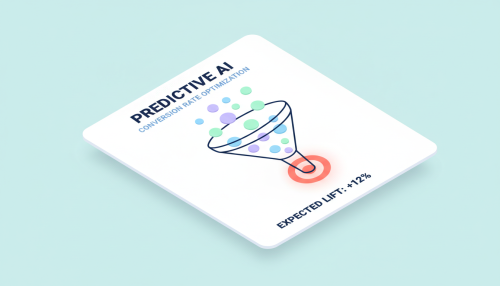
The conversion rate is the point where your marketing budget turns into revenue. The same volume of traffic can deliver anything from one to three times the return depending on how you optimise this decisive moment. In 2026, two schools of thought compete to achieve this: artificial intelligence predictive AI, which anticipates and personalises, and manual testing, which measures and proves.
The debate is often framed as a duel, when it is really a question of how to combine both. Each approach excels in specific areas and falls short in others. Confusing them or neglecting one means leaving conversion on the table.
Here is what each method genuinely brings, its limitations, and how to decide which to adopt for your situation.
Key points of this article
- Predictive AI anticipates and personalises; manual testing measures and proves.
- Predictive lead scoring focuses effort on high-potential prospects.
- Testing remains the only real proof of what converts with your audience.
- A prediction based on limited data remains fragile and involves your personal data.
- Combining both, with human oversight, outperforms either approach used in isolation.
Two Approaches, Two Promises
Predictive Predictive AI applied to conversion continuously analyses visitor behaviour to anticipate their intentions, score prospects and adapt the experience in real time. Manual testing, on the other hand, pits several versions of a page or message against real traffic, and observes which one wins. One predicts, the other proves.
AI adoption is no longer experimental: according to Salesforce, 84% of marketing professionals already use it or plan to do so in their workflows. The real question is therefore no longer whether to use it, but where it adds value and where the human remains indispensable.
Definition: Predictive AI for Conversion
Predictive AI applied to conversion encompasses machine learning models that estimate, from historical and behavioural data, the probability that a visitor or prospect will complete an action. It feeds three main uses: lead scoring, dynamic personalisation and prioritisation of optimisations.
Ce que l’Predictive AI apporte au conversion rate
The Predictive lead scoring
This is the most mature use case. Predictive lead scoring analyses a multitude of data points to estimate the conversion probability of each prospect and rank them automatically. Your teams then focus their energy on high-potential contacts, instead of treating everyone the same way. The result: a faster pipeline and less time wasted on irrelevant leads.
Dynamic Personalisation
AI adapts content, offers or even the length of a form based on the anticipated behaviour of the visitor. A high-intent profile sees a shortened journey; a hesitant visitor receives a reassurance argument. This personalisation in real time goes beyond simple segmentation and takes effect before the visitor leaves the page.
Friction Point Detection
By analysing thousands of sessions, AI instantly identifies the blockages in a conversion funnel, where a human would spend hours on heatmaps. landing pages are in fact where this approach produces the fastest results, as they can be optimised without touching the rest of the site.
What Manual Testing Keeps That Cannot Be Replaced
However powerful it may be, a prediction remains a probability, not a proof. It indicates what is likely to work, never what actually works with your audience, today. Only a test run against real traffic provides that certainty.
The figures also call for caution around full automation. A study covering several hundred online stores showed that expert-led optimisations delivered 28 to 34% conversion gains, compared with 4 to 7% for tools left in full autonomy. Predictive écart ne vient pas de la technologie, mais de la présence d’un practitioner qui cadre les hypothèses, interprète les résultats et attend une vraie signification statistique avant d’agir.
Predictive AI et testing manuel en comparaison
|
Criterion |
Predictive AI |
Manual Testing |
|---|---|---|
|
Nature of result |
An estimated probability |
A measured proof |
|
Speed |
Immediate |
Days to weeks |
|
Use case |
Scoring, personalisation, priorisation |
Validating a specific change |
|
Reliability |
Variable depending on data |
High if the test is well run |
|
Data |
Requires personal data |
Aggregated behaviours |
Lead scoring, personalization, A/B testing and data analysis: discover how to combine AI and human expertise to optimize your conversion rate.
So, Which Approach Should You Take?
The answer depends on your maturity and volume, not on trends. Here is the framework we apply.
- Low traffic or limited data: start with structured testing. Without volume, AI has nothing to learn from and its predictions remain fragile.
- Sufficient volume: deploy AI to score your leads, personalise journeys and prioritise high-potential tests.
- High-stakes decisions: always validate a change to pricing, messaging or funnel with a real test. A prediction is not enough.
- Keep humans in control: AI proposes, the team decides based on business rationale, brand and long-term value.
- Think ecosystem: conversion is an ongoing process, not a series of one-off tests. Also focus on traffic quality upstream, as better traffic produces better data.
The Key Watch-Out: Your Personal Data
One aspect is too often overlooked. Predictive scoring et la personalisation reposent sur la collecte et l’analyse de personal data. À ce titre, ils entrent pleinement dans le champ du RGPD : consentement, transparence sur la logique de traitement et respect des droits des personnes sont obligatoires.
Entrusting a commercial decision to an opaque model also raises a question of explainability. A business must be able to justify why a prospect was prioritised or excluded. Using AI without this framework creates legal risk and a loss of trust far more costly than the anticipated gain.
Doko, Your Acquisition and Conversion Partner in Lyon
Doko is a Lyon-based web marketing agency with a human scale, based in La Mulatière. As a Google Premier Partner, we help businesses improve their conversion rate by combining the right tools with a rigorous method, from landing pages to Google Ads.
Our position on predictive AI is clear: it is a powerful upstream accelerator, provided that decisions that matter are validated by real tests and data remains under your control. We work on real data, without making promises of miracles. Want to optimise your conversion without wasting your traffic? Request a quote.
FAQ : Predictive AI et conversion rate
What Is the Difference Between Predictive AI and Manual Testing?
Predictive Predictive AI estime une probability of conversion from past data, and personalises accordingly. Manual testing pits versions against real traffic to measure which one wins. One anticipates, the other proves.
The Predictive lead scoring est-il fiable ?
It is all the more reliable when it has clean, abundant data. On a limited history, its predictions remain approximate. It must always be supervised and reassessed, as customer behaviours evolve.
Is Predictive AI Suitable for a Small Business?
With caution. Models improve as they accumulate data. A young business often benefits from relying first on tests and thorough behavioural analysis before automating.
Does the GDPR Apply to Predictive Scoring?
Oui, pleinement. The scoring et la personalisation traitent des personal data et supposent consentement, transparence et respect des droits des personnes. Predictive entreprise doit aussi pouvoir expliquer ses décisions.
Do You Need a Data Scientist to Get Started?
Not necessarily, as the tools have become widely accessible. However, a practitioner who frames the hypotheses, interprets the scores and enforces rigour remains the decisive success factor, far more than the tool itself.