Will Gemini Replace Traditional Google Search in 2026?
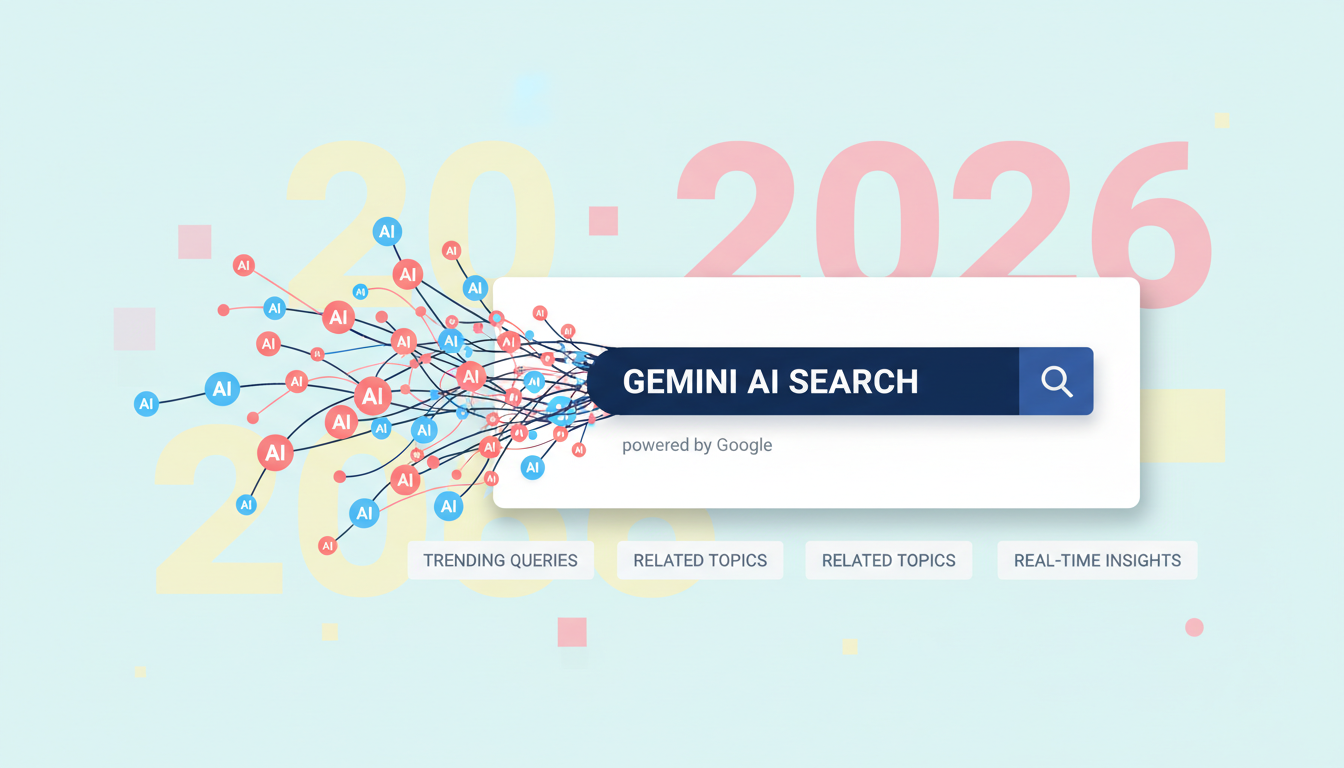
The question has been stirring the entire sector since the Google I/O conference of May 2026, where the company presented what it describes as the biggest overhaul of its engine in more than twenty-five years. Some headlines are already announcing the death of the ten blue links. The reality deserves a closer look: Gemini is not replacing Google Search, it is becoming its brain.
The distinction is not cosmetic. Google is not closing its engine to redirect you to a competing application: it is absorbing artificial intelligence into the interface that billions of people already use. For businesses, the consequence is very concrete: ranking well is no longer sufficient, you need to be cited.
Here is what has really changed, what applies in France, and how to adapt your strategy.
Key takeaways from this article
- Gemini now powers AI Overviews and AI Mode in Google Search by default.
- AI Mode has exceeded one billion monthly active users, AI Overviews claims 2.5 billion.
- Google states that classic links are not disappearing, but their place is shrinking.
- AI Mode is not yet available in France, for regulatory reasons.
- Being in the organic top 10 no longer guarantees being cited in a generated response.
Gemini: The Engine of Google Search
For a long time, Gemini was perceived as Google’s response to ChatGPT: a separate application, with its assistant conversational interface. That is still the case, and the application claims approximately 900 million monthly users. But the main action is happening elsewhere.
Since January 2026, the model Gemini 3 powers AI Overviews by default, those summaries displayed at the top of results. AI Mode, the conversational experience integrated into the engine, now runs on Gemini 3.5 Flash. In other words, when you search on Google, Gemini is already working behind the scenes. The question is therefore no longer whether it will replace the engine: it is the engine.
Definition: AI Mode
AI Mode is a conversational interface integrated into Google Search. Instead of displaying a list of links, it produces a synthesis response accompanied by citations, and allows follow-up questions to be chained. It relies on the query fan-out technique: the question is broken down into numerous sub-queries, whose results are then synthesised.
What Google Announced in 2026
The overhaul presented at Google I/O 2026 goes well beyond a summary at the top of the page. The search field itself has been redesigned for the first time in twenty-five years: it now accepts text, images, videos and files, and offers suggestions formulated by AI.
- Generative interfaces: for a complex question, the engine builds an interactive response on the fly, with simulations, dashboards or personalised calculators, rather than a simple text.
- Information agents: agents monitor the web in the background and send you syntheses, in a logic of automated intelligence.
- Agentic capabilities: booking local services, comparing availability, and even telephone calls made to establishments on your behalf.
- Personal Intelligence: the optional connection of your Gmail and Google Photos data to refine responses, deployed in nearly 200 countries and 98 languages.
An important point, often forgotten in alarmist headlines: Google states that search will continue to offer a variety of results, and that generated responses include visible links to sources. Links are not disappearing. Their place, however, is shrinking.
Google Search Yesterday and Today
|
Criterion |
Classic search |
Search with Gemini |
|---|---|---|
|
Result |
A list of ten blue links |
A synthesis response citing its sources |
|
Interaction |
One query, one results page |
A conversation, with follow-up questions |
|
Format |
Text and links |
Interactive interfaces generated on the fly |
|
SEO objective |
Ranking in the top 10 |
Being cited in the response |
|
Adoption |
Universal |
More than one billion users on AI Mode |
Audit, structuring, and optimization. We implement a tailored GEO strategy to attract more clients.
And in France? A Particular Situation
There is no point looking for AI Mode on French Google: it is not there yet. France has remained on the sidelines of these deployments, not for technical reasons, but regulatory ones, due to neighbouring rights law that governs the reuse of press content and the European framework.
This exception is however only a reprieve. AI Overviews are expected in France during the summer of 2026, following an agreement with publishers. French businesses therefore have a rare window: that of preparing their visibility before the wave arrives, rather than being caught off guard by it. This is precisely the purpose of search engine optimisation in the AI era.
What This Changes for Your Visibility
Here is the observation that should hold your attention: according to available analyses, only approximately half of the domains cited in AI Mode also appear in the top ten classic organic results. Each response cites an average of seven domains. Being first on Google therefore no longer guarantees appearing in the response. The engine no longer only selects the best-ranked pages: it retains those whose content is the most reliable, the best structured and the most easily extractable. This is a shift in terrain, not a simple algorithm update. It shifts part of the SEO work towards Generative Engine Optimization, which targets citation rather than ranking.
How to Adapt Your Strategy?
None of this invalidates organic search. The foundation remains indispensable, but a layer must be added to it. Here are the priority workstreams.
- Answer before developing: place the answer at the top of your paragraphs, in autonomous and extractable blocks, rather than after three introductory paragraphs.
- Structure for the machine: Schema.org structured data, FAQ, explicit titles. This is the heart of optimisation technique on-site.
- Cover the subject in depth: the query fan-out breaks a question into dozens of sub-queries. Superficial content will never be retained.
- Reinforce your brand authority: models favour recognised entities and sources cited elsewhere on the web.
- Measure your citations: regularly test your strategic queries on Gemini, ChatGPT and Perplexity to track your actual presence.
- Diversify your channels: brand, newsletter, social networks, YouTube. Depending solely on organic traffic is becoming a risky bet.
Doko, Your Partner in the Face of Generative Search
Doko is a human-scale Lyon-based webmarketing agency, based in La Mulatière. A Google Premier Partner, we support businesses through this transition, treating organic search and visibility in answer engines together, including ChatGPT.
Our conviction: France benefits from an involuntary head start. Businesses that structure their content now will be cited when AI Mode arrives; the others will discover the problem once their traffic has declined. We work on real data, without promising miracles. Request a quote.
FAQ: Gemini and Google Search
Does Gemini Really Replace Google Search?
No, it does not replace it: it powers it. Gemini has become the default model behind AI Overviews and AI Mode. Google keeps its engine, its links and its results, but the generated response is taking an increasingly prominent place at the top of the page.
Will the Blue Links Disappear?
Google states the contrary: search will continue to offer a variety of results, and generated responses include links to sources. Their visibility is diminishing, however, and a growing share of searches ends without any click.
Is AI Mode Available in France?
Not yet. France has remained on the sidelines of these deployments for regulatory reasons, linked notably to neighbouring rights. AI Overviews are however expected during the summer of 2026.
What is the Difference Between AI Overviews and AI Mode?
AI Overviews are summaries displayed above classic results. AI Mode is a complete conversational experience, where the user engages in dialogue and refines their search, in the manner of a chatbot integrated into the engine.
Has SEO Become Useless?
No. Generative engines draw from the indexed web: without a solid SEO foundation, your pages will never be candidates for citation. SEO remains the foundation, GEO is the complementary layer.