Google Ads in 2026: Performance Max, Search or Display, Which Should You Prioritise?

C’est la question qui revient dans presque chaque premier rendez-vous : sur quel campaign type should you bet on? Google is pushing Performance Max insistently, the search network remains the safe bet, and Display promises massive visibility for a few euros. Three promises, three logics, and a budget that is not unlimited.
The question itself deserves to be reframed. In 2026, these three formats are not three competing options between which you must choose: they are three tools that respond to different moments in the purchasing journey. Worse, one of the three is in the process of disappearing in its current form, which many advertisers still do not know.
Here is how each format really works, what has changed this year, and how to allocate your budget without wasting it.
Key takeaways from this article
- The search network captures existing intent: it is the foundation of every Google Ads account.
- Performance Max broadcasts across all Google inventory and is used for scaling, once data is solid.
- Classic Display has been migrating to Demand Gen since June 2026.
- Performance Max has become much more transparent: channel report, search terms, negative keywords.
- Search and Performance Max complement each other, but can also cannibalise each other without safeguards.
Understanding the Three Campaign Types
The Search Network: Capturing Existing Demand
Campaigns on the search network display your text ads at the precise moment a user types a query. It is the most intent-driven format on the search engine: the person is actively looking for what you sell, they are already in a buying mindset. You retain control over keywords, match types, exclusions and landing pages.
It is also the most readable format: you know exactly which query triggered which click, at what cost. This transparency makes it the natural foundation of every account, and the starting point we recommend almost systematically to an advertiser who is just starting out.
Performance Max: Broadcasting Everywhere, Driven by AI
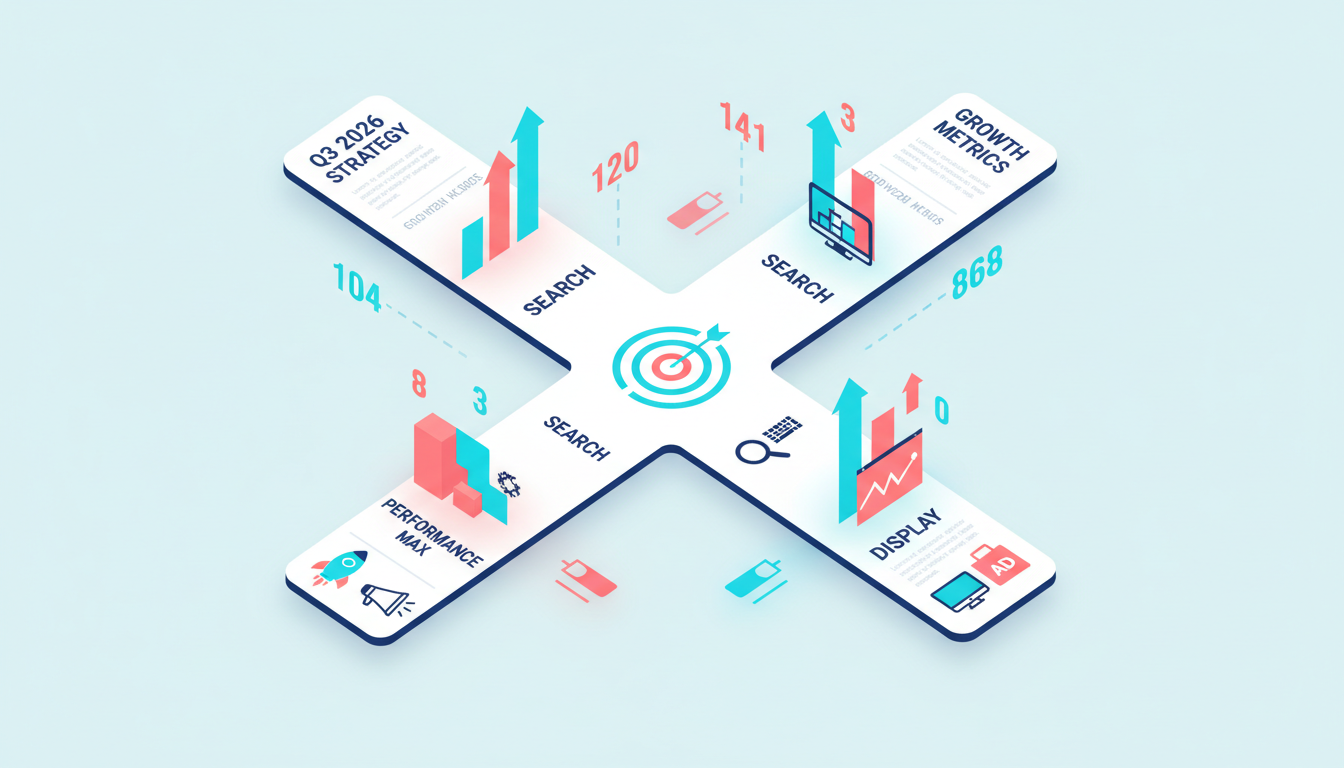
Performance Max, often abbreviated as PMax, is a unique campaign type that broadcasts across the entire Google network: search, Shopping, YouTube, Display, Discover, Gmail and Maps. You provide visuals, headlines, descriptions and a conversion objective, then the algorithm alone decides the budget allocation, formats and audiences.
Its strength is coverage: a single campaign to be present everywhere, with a learning process that discovers audience pockets you would not have identified. Its historical weakness was opacity. On this point, the situation has changed significantly, as we will see.
Display: Broad Visibility, but a Format in Transition
Les campagnes Display campaigns display visual banners on Google’s partner sites. The cost per click is low and the reach considerable, but intent is almost non-existent: nobody has asked for anything. This format serves brand awareness and above all remarketing.
And here is the information that few advertisers have taken on board: since June 2026, Google has been switching classic Display campaigns to Demand Gen, its demand generation format on YouTube, Discover, Gmail and the Display network. In other words, building a strategy on standalone Display today means building on a format in the process of being absorbed. Display still has value for remarketing or very controlled placement buys, but it is no longer a pillar.
Comparison Table of Formats
|
Format |
Intent |
Control |
Best used for |
|---|---|---|---|
|
Search network |
High |
Full |
Capturing existing demand |
|
Performance Max |
Variable |
Partial |
Scaling with solid data |
|
Display |
Low |
High |
Remarketing and targeted placements |
|
Demand Gen |
Low to medium |
Good |
Creating demand upstream |
Audit, account structuring and ongoing optimization. We allocate your Google Ads budget where it generates real returns.
Performance Max is No Longer the Black Box of 2021
The criticism was well-founded at its launch: you entrusted a budget to Google without knowing where it went. Under pressure from advertisers, Google has since delivered several substantial updates that change the picture.
- The channel report: you can now see the breakdown of your performance between search, YouTube, Display, Discover, Gmail and Maps. Knowing whether your budget is going to high-intent Search or brand awareness Display completely changes how you read your cost per conversion.
- The timeline view: added in April 2026, it shows the evolution of each channel’s contribution over time.
- Search terms: the report is accessible for Search and Shopping placements, which finally allows you to verify the relevance of the triggered queries.
- Negative keywords: now available at the campaign level, in high volume, to regain control over drifts.
- Asset reports: Google indicates which headlines, images and videos are performing, in order to renew underperforming creatives.
The honest assessment: PMax has moved from a black box to a grey box. You see part of what is happening and you can act on several levers, but transparency remains lower than that of a Search campaign. Above all, automation does not dispense with thinking: the algorithm optimises what you ask it to optimise. Poorly configured conversion objectives will produce poorly directed results, with formidable efficiency.
So, What Should You Prioritise in 2026?
The answer depends on your maturity, not the trend of the moment. Here is the framework we apply on the accounts we manage.
You Are Just Starting Out: Search Network First
Without a conversion history, Performance Max has nothing to learn from. Start by capturing existing demand with well-structured Search campaigns, on high-intent keywords. You will generate clean data that will serve as fuel for any subsequent automation.
You Have Solid Data: Add Performance Max
Once conversion tracking is reliable and a sufficient volume reached, PMax becomes an excellent accelerator, particularly in e-commerce with a clean product feed. It does not replace your Search campaigns: it complements them by seeking incremental reach across the rest of Google’s inventory.
You Want to Create Demand: Demand Gen Rather Than Display
If your challenge is to make an offer known to people who are not yet searching for you, Demand Gen is today the appropriate format, with real creative and audience control. Reserve Display for remarketing and precise placements, knowing that the format is evolving.
The Most Common Pitfall We See
A poorly structured account allows Performance Max to cannibalise its own brand campaigns. PMax captures queries on your name, those you would have obtained anyway, at lower cost, or even for free organically. The results displayed appear excellent, the cost per acquisition is flattering, and yet the acquisition of new customers stagnates.
The remedy comes down to three actions: excluding your brand from PMax, maintaining a dedicated brand Search campaign, and monitoring the share of conversions from the Search channel in the channel report. This is typically the kind of invisible setting that separates a profitable account from one that gives the illusion of being so. It is also what we look for as a priority during a Google Ads campaign.
Doko, Your Google Ads Partner in Lyon
Doko is a human-scale Lyon-based webmarketing agency, based in La Mulatière. A Google Premier Partner, a distinction reserved for the top 3% of Google partners in France, we manage accounts daily on the search network, Shopping, Performance Max and YouTube.
Our conviction: there is no universally good format, only an allocation adapted to your maturity, your margins and your objectives. We work on real data, we document every trade-off and we measure its impact, without promising miracles. Want to know where your budget is really going? Our Google Ads consultant will go through it with you.
FAQ: Google Ads Campaign Types
Do You Have to Choose Between Performance Max and the Search Network?
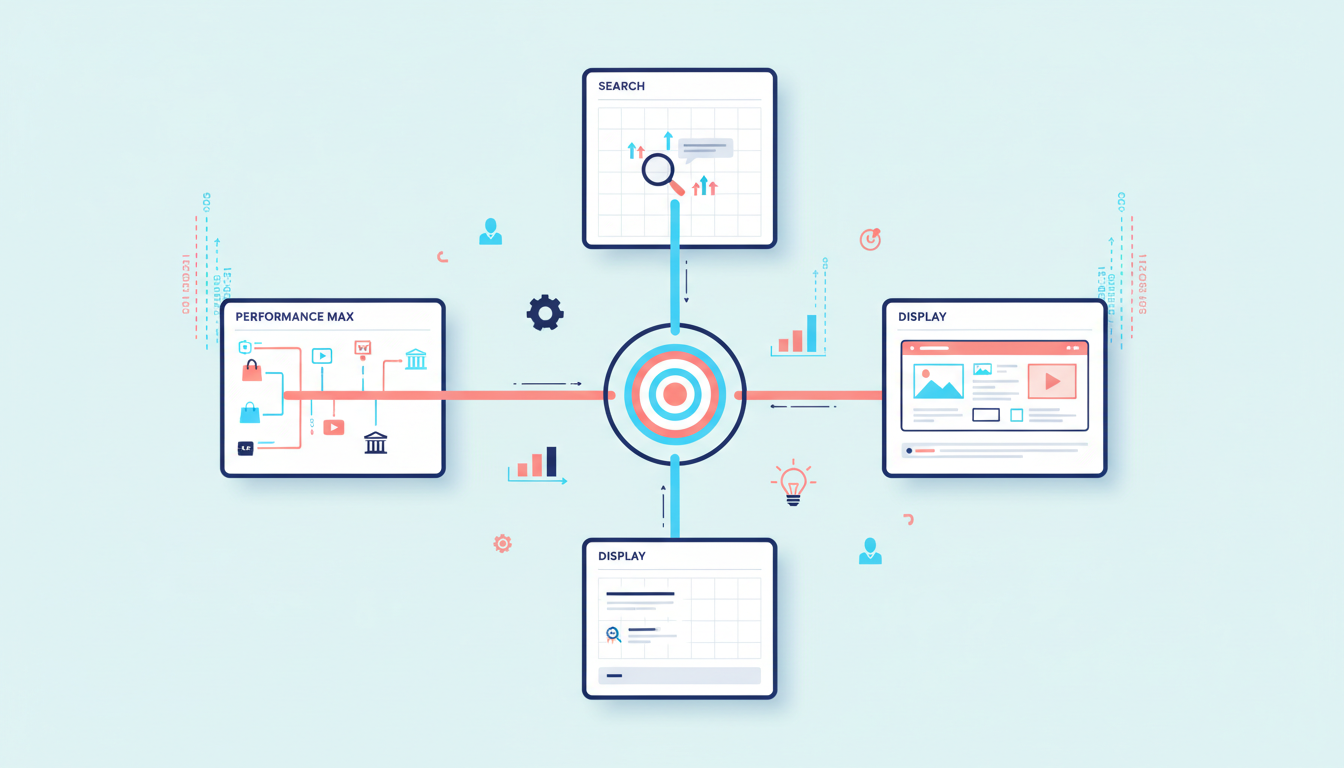
No, the two are combined. The search network captures existing intent with full control, Performance Max goes looking for reach across the rest of Google’s inventory. Think complementarity, while ensuring they do not cannibalise each other.
Is Performance Max Suitable for a Small Business?
Not always. The algorithm needs a sufficient volume of conversions to learn. With a modest budget and little history, it is better to concentrate resources on targeted Search campaigns before automating.
Will Display Disappear from Google Ads?
Classic Display campaigns have been progressively switching to Demand Gen since June 2026. Display inventory remains accessible, but it now integrates into a broader format. For a new project, Demand Gen is the relevant choice.
How Do I Know Where My Performance Max Budget is Going?
Use the channel report, available in the interface, which breaks down your performance between search, YouTube, Display, Discover, Gmail and Maps. The timeline view also shows the evolution of each channel over time.
What Budget Should You Plan for Starting on Google Ads?
It all depends on your sector and the cost per click of your keywords. Below a certain threshold, automation lacks the volume to learn. A budget concentrated on a few well-targeted campaigns is better than a budget dispersed across all formats.