- Source : https://gs.statcounter.com/search-engine-market-share
- Source : https://gs.statcounter.com/search-engine-market-share/all/france
- Source : https://en.wikipedia.org/wiki/AI_Overviews
- Source : https://about.ads.microsoft.com/en-us
- Source : https://en.wikipedia.org/wiki/Microsoft_Advertising
- Source : https://support.google.com/google-ads
Microsoft Ads vs Google Ads in 2026: Is the Advertising Duel About to Turn?
Résumer avec :
[en] SEA

Will Microsoft Ads finally threaten Google Ads‘ dominance? At Doko, this question comes up every year in our client discussions.
The figures settle it quickly. In August 2026, Google captures 91.1% of searches worldwide, compared to 4.5% for Bing (StatCounter). In France: 88.76% versus 5.13%.
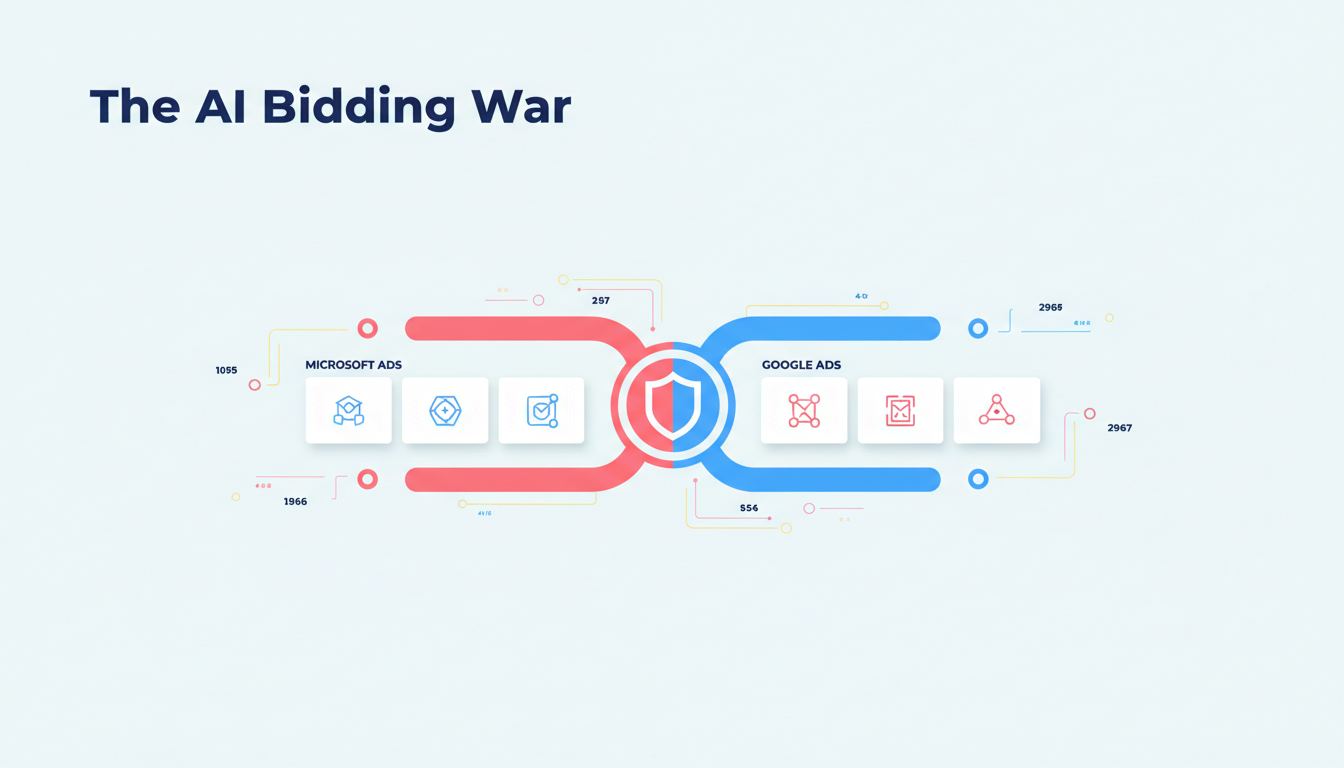
The Microsoft Ads vs. Google Ads battle revolves around a real issue: the allocation of advertising budgets, not a change in market leader.
Key takeaways
- Google Ads maintains an overwhelming lead: a 91.1% global market share and 88.76% in France (StatCounter, August 2026).
- Microsoft Ads rely on an expanded network (Bing, Yahoo, DuckDuckGo, Ecosia) and an audience reputed to be more mature.
- The lower CPCs often reported on Microsoft Ads remain an observed reality on the ground, not a guaranteed official statistic.
- The tool for importing Google Ads campaigns into Microsoft Ads significantly simplifies initial testing.
- The choice is not limited to Google Ads or Microsoft Ads; it involves the smart allocation of the budget between the two platforms.
State of Play: Does Google Ads Remain the Undisputed King of Online Advertising?
Global and French Market Share: David vs Goliath?
StatCounter figures from August 2026 confirm a stable balance of power. Globally, Google captures 91.1% of searches, far ahead of Bing (4.5%), Yahoo! (1.23%), and Yandex (0.99%).
In France, the gap narrows only slightly: Google remains at 88.76%, while Bing advances to 5.13%. Two other players are also present: Ecosia (1.4%), linked to Bing through a partnership, and Qwant (0.83%).
Part of the traffic captured by Ecosia therefore lands in the Microsoft Ads ecosystem: the real gap is smaller than Bing’s market share alone suggests.
The Google Ecosystem: Unmatched Firepower
Google Ads is no longer limited to the traditional search engine. Since May 2025, AI Overviews have been rolled out across more than 200 countries, with ads tested in AI Mode as early as March 2025.
A Botify x Demandsphere study (December 2024) illustrates this: AI Overviews and featured snippets combined occupy approximately 67.1% of the screen on desktop and 75.7% on mobile.
Definition: AI Overviews are the AI-generated summaries from Google, displayed at the top of search results, which synthesizes the response before the user even clicks a link.
For advertisers, this space redistributes attention, but remains managed from Google Ads, through its generative AI tools such as AI Max for Search campaigns.
Microsoft Ads (Bing Ads): The Outsider Reshuffling the Deck
The Microsoft Network: An Often More Mature and Qualified Audience
Microsoft Advertising relies on a search network comprising Bing, Yahoo, DuckDuckGo and Ecosia, supplemented by a display offering across MSN, Edge, Outlook and Microsoft Casual Games.
The industry often presents the Microsoft Ads audience as older and more professional, with Bing being the default engine on Edge in enterprise. Aucune donnée démographique chiffrée officielle ne confirme ce profil: it is a widespread marketing argument, not a statistic published by Microsoft.
For a B2B advertiser or one selling premium products, this positioning remains an interesting targeting angle worth testing.
AI Integration (Copilot): Microsoft’s Acceleration Move
Copilot, integrated into Microsoft Advertising, acts as an AI assistant: it helps create campaigns, generate keywords and optimise bids.
Note : Copilot is not the equivalent of Google’s AI Overviews. It is not an ad format shown to users, but a productivity tool on the campaign management side.
This type of assistant saves real time, especially when structuring a campaign from scratch.
The Head-to-Head: Microsoft Ads vs Google Ads on the Key Criteria
Here, side by side, is how they compare on the criteria that really matter to an advertiser.
| Criterion | Google Ads | Microsoft Ads |
|---|---|---|
| Global market share (Aug 2026) | 91,1 % | 4,5 % |
| France market share (Aug 2026) | 88,76 % | 5,13 % |
| Search network | Google, YouTube, search partners | Bing, Yahoo, DuckDuckGo, Ecosia |
| Average CPC | Market reference | Often lower (field observation, non-official) |
| AI tool (advertiser side) | AI Max, generative AI tools | Copilot (helps create campaigns) |
| Campaign import | — | Native import from Google Ads |
Microsoft Ads vs Google Ads: which platform should you choose in 2026?
CPC, market share, targeting, AI and campaign imports: compare both platforms and find the right balance for your acquisition strategy.

Cost Per Click (CPC) and Return on Investment (ROI): Where Is the Best Return?
The figure crops up in almost every industry article, like an urban legend: Microsoft Ads supposedly costs 30% to 50% less than Google Ads. No official study confirms this percentage.
What is true is that lower CPCs are regularly observed on Microsoft Ads in highly competitive sectors—thanks to a smaller pool of bidders—though this is not a universal rule.
Note : always compare CPC by sector and keyword before relying on a generic percentage found online — this is the reflex we apply on every audit at Doko.
The ROI therefore depends on the sector, the level of competition, and the budget already invested in Google Ads.
Targeting Features and Ad Formats
The network remains as described above (Bing, Yahoo, DuckDuckGo, Ecosia), supplemented by display on MSN, Edge, Outlook and Microsoft Casual Games.
Google Ads maintains an advantage in volume and formats: Search, Display, Shopping, YouTube, Performance Max, with more granular targeting.
Microsoft Ads offers equivalent formats with compelling professional targeting options—notably via LinkedIn—to refine the B2B audience.
User Interface, Management and Import Features
Microsoft Advertising has built its interface to reassure advertisers familiar with Google Ads: campaigns, ad groups, keywords, bids.
The most tangible argument for testing the platform remains the Google Ads campaign import tool for Microsoft Ads: structure, keywords, and bids are imported directly, without manual re-entry.
- Connect your Google Ads account to Microsoft Advertising.
- Select the campaigns to import.
- Check and adjust bids and budgets based on search volume on the Microsoft network.
- Run a short-term test before making a decision.
This feature significantly reduces duplication work and makes testing much less time-consuming.
Why 2026 Is the Pivotal Year for Microsoft Ads
The Evolution of Search Engines in the Face of Conversational Chatbots
Search is changing its face, with AI Overviews et l’AI Mode already redistributing attention. On Microsoft’s side, Copilot remains confined to campaign management.
This context remains favorable to Microsoft Ads: every evolution in search drives advertisers to diversify their channels.
Advertiser Diversification to Escape Google Saturation
In highly competitive sectors, Google Ads bids rise and cost per click follows, pushing advertisers towards other growth channels. Microsoft Ads benefits from this movement, especially since campaign import makes testing easier.
This diversification does not mean abandoning Google Ads; it aims to spread risk and capture complementary traffic that is often less competitive.
Which Platform Should You Choose for Your 2026 Acquisition Strategy?
When Should You Prioritise Google Ads?
Google Ads remains the default choice for any strategy targeting volume: it is where 91.1% of global searches take place.
Prioritise it for broad, fast coverage, a mature AI ecosystem (AI Max, Performance Max) or fine-grained targeting.
Why You Should (Also) Test Microsoft Ads
Testing Microsoft Ads makes sense as soon as your sector is saturated on Google, or when your target matches the professional profile often associated with Bing.
At Doko, we often start with a split close to 80/20, then adjust based on results. This is not an official rule, just a common starting point among PPC managers.
Unsure about the ideal split between Google Ads and Microsoft Ads? At Doko, we can audit your campaigns and help you structure this test without starting from scratch.
FAQ – Your questions about Microsoft Ads vs. Google Ads
Is Microsoft Ads Really Cheaper Than Google Ads?
Often, but not systematically. Many advertisers report lower CPCs, sometimes by 30 to 50%, but no official study guarantees this gap, which depends on competition.
Can You Import Your Google Ads Campaigns into Microsoft Ads?
Yes. Microsoft Advertising offers a native import tool that takes the structure, keywords and bids, without manual re-entry.
What Is the Target Audience for Microsoft Ads?
The industry often presents it as older and more professional, with Bing being the default engine on Edge in enterprise. No official data confirms this profile.
Will Microsoft Surpass Google in 2026?
Not in volume. Google retains 91.1% of global share and 88.76% in France, versus 4.5 to 5.13% for Bing (StatCounter). The 2026 dynamic is about budget diversification, not a change of leader.
Should You Split Your Budget Between Google Ads and Microsoft Ads?
It is an option worth testing. A common approach is to start with a split close to 80/20, then adjust. This is not a rule imposed by Google or Microsoft.
Sources

Articles relatifs
[en] SEA
[en] SEO
[en] Stratégie