Perplexity vs Google in 2026: Revolution or Passing Trend?
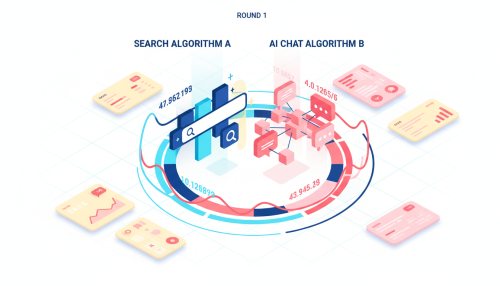
Perplexity vs Google: the matchup has the feel of David versus Goliath — a conversational answer engine launched in late 2022 going up against a giant that has shaped our search habits for twenty years.
First figure to set the record straight: Google retains 91.1% of global market share of search in August 2026, according to StatCounter. Perplexity remains, despite its media noise, a niche player on a global scale.
So, a genuine turning point or simply a trend? This comparison reviews their respective features and strengths.
Key takeaways
- Google domine toujours largement, avec 91.1% of global market share (StatCounter, août 2026).
- Perplexity processed approximately 780 million queries in May 2025, a volume growing rapidly but incomparable to Google’s.
- Perplexity has returned to being virtually ad-free since February 2026, after testing an advertising model in 2024.
- Google has evolved its search through AI Overviews and then AI Mode, successors to the SGE project unveiled in 2023.
- The right choice depends on the use case: monitoring and in-depth research for Perplexity, ecosystem and shopping for Google.
What Is Perplexity AI and Why Is It Disrupting Google?
The conversational answer engine model
Perplexity does not return a list of blue links. It synthesises a written response drawn from multiple web sources, consulted in real time.
Definition : a conversational answer engine combines a large language model and a live web search to produce a direct, sourced response to a question posed in natural language.
Founded in late 2022 by Aravind Srinivas, Denis Yarats, Johnny Ho and Andy Konwinski, Perplexity relies on several models (GPT, Claude, Gemini, among others, depending on the plan) as well as its own models, with systematic citation of sources.
The Ad-Free (or Near Ad-Free) User Experience
Perplexity has long played the card of the clean interface, without sponsored links. Yet this positioning has gone back and forth.
In July 2024, the company tested an advertising revenue-sharing arrangement with publishers, partly in response to plagiarism accusations, before abandoning this strategy in February 2026 to return to a subscription-first model, centred on the Perplexity Pro subscription.
Note: The Perplexity experience has now returned to being virtually ad-free, in order to maintain user trust in the objectivity of the answers.
Perplexity vs Google: The Key Feature Match
Precision and Contextualisation of Sources
Perplexity systematically cites its sources under each response, which makes verification easier. Google, for its part, still offers a range of pages, supplemented by AI-generated summaries.
The difference lies in the intent: Perplexity builds a single response from cross-referenced sources, while Google leaves the user to dig through the results themselves.
Local Search and Real-Time News
On breaking news, Perplexity queries the web in real time and aggregates multiple recent sources into a single response. Google remains the reference for local search, thanks to its native integration with Maps.
Multimodality and Content Generation
Both tools now incorporate images into their responses. Perplexity also allows documents to be imported and summaries generated from them, useful for quickly digesting a long report.
Google, through its integration into the Workspace ecosystem, remains broader but less specialised for this specific use case.
| Criterion | Perplexity | |
|---|---|---|
| Response format | Sourced conversational synthesis | Organic links + AI summaries |
| Advertising | Near-absent since February 2026 | Sponsored links throughout |
| Local search | Limited | Native Maps integration |
| Business model | Freemium (free + Perplexity Pro) | Free, funded by advertising |
| Volume / market share | Niche, 780M queries/month (May 2025) | 91.1% market share (August 2026) |
Conversational search, generative AI, local visibility and SEO: discover the strengths of each search engine and why your strategy should now cover both.

Advantages and Limitations: Why Choose One Over the Other?
The match does not come down to a single winner: it is a question our clients ask us regularly in audits, and the answer almost always comes down to the use case rather than the tool.
Perplexity’s Strengths for Monitoring and In-Depth Research
Perplexity excels on complex queries, those that require cross-referencing multiple sources to build a response. A professional doing information monitoring saves time by avoiding opening ten tabs.
According to the latest figures shared by Aravind Srinivas, CEO of Perplexity, at the Bloomberg Tech Summit 2025, the tool processed 780 million queries in May 2025, with monthly growth exceeding 20%. No more recent data has been published since.
In practice, here are three use cases where Perplexity makes the difference:
- Quickly compare several viewpoints on a technical subject.
- Summarize a long document or an imported report.
- Follow a developing news story without having to conduct multiple searches.
Google’s Supremacy for the Ecosystem, Shopping and Local Queries
Google remains unbeatable when it comes to online shopping, local navigation or uses connected to Gmail, Android or Maps. This integrated ecosystem, which Perplexity does not replicate, carries great weight in users’ habits.
The Future of Online Search: Should Google Be Worried?
The Perplexity vs Google duel is far from settled.
Google’s Evolution with Search Generative Experience (SGE) / AI
The SGE project, unveiled at Google I/O in May 2023, was the experimental version of generative search from Google.
SGE has since changed its name and status. Renamed AI Overviews in May 2024, it is now deployed in more than 100 countries. A second feature, AI Mode, has been testing a page of results entirely generated by AI since March 2025, distinct from the classic AI Overviews.
SGE therefore no longer exists as such: this code name referred to a test phase, since replaced by products already deployed.
The Business Models of Both Giants Facing Content Creators
Advertising remains Google’s dominant revenue source, even if the company no longer communicates a precise breakdown by format. Perplexity, on the other hand, has been betting on the Perplexity Pro subscription since its return to subscription-first.
This difference in model affects content creators. Perplexity is the subject of several disputes for unauthorised use of content, notably with the BBC, Dow Jones and the New York Times, as well as allegations of contested scraping.
At Doko, this is a question we are asked more and more in SEO audits: should you already be writing for conversational engines, or stay focused on Google? Our answer fits in one sentence: you need to cover both fronts, without sacrificing one for the other. Need clarity on your own strategy? The Doko team offers a free SEO audit to take stock.

FAQ: Everything You Need to Know About the Perplexity vs Google Duel
What Exactly Is Perplexity AI?
Un conversational answer engine qui combine un grand modèle de langage et une recherche web en temps réel, avec citation systématique des sources. Fondé en 2022 par Aravind Srinivas et son équipe.
Is Perplexity Completely Free?
Yes, in a free version with no mandatory sign-up. The Perplexity Pro subscription unlocks more advanced models, document import and API access.
Will Google Disappear Because of Perplexity?
Nothing suggests this at this stage. With 91.1% of global market share and an integrated ecosystem (Android, Gmail, Maps, Shopping), Google remains dominant and is itself responding to AI pressure through AI Overviews and AI Mode.
Which Tool Is Best for Monitoring or Document Research?
Perplexity stands out for quickly synthesising multiple sources on complex queries. Google remains preferable for local search, shopping and its tool ecosystem.
How Does Perplexity Handle Sources and Plagiarism?
Perplexity systematically cites its sources, mais fait l’objet de litiges avec plusieurs médias (BBC, Dow Jones, New York Times) pour unauthorised use of content.
Sources
- Source : https://en.wikipedia.org/wiki/Perplexity_AI
- Source : https://en.wikipedia.org/wiki/AI_Overviews
- Source : https://en.wikipedia.org/wiki/Alphabet_Inc.
- Source : https://gs.statcounter.com/search-engine-market-share