Bing Webmaster Tools: The New Features for AI Reports
For two years, search engine optimisation in answer engines has been hitting a simple obstacle: nobody could measure anything. We knew that ChatGPT, Copilot or Gemini cited sources, without ever being able to access the figures. Agencies were testing queries manually, for lack of anything better.
This blind spot has just been reduced, and it comes neither from Google nor from OpenAI. It is Microsoft that opened the door first, by integrating into Bing Webmaster Tools a dashboard dedicated to citations in AI-generated responses. Free, official, and enriched in June 2026 with four features that finally make it usable.
Here is what these reports contain, what they really allow you to do, and above all what they do not show.
Key takeaways from this article
- The AI Performance report was launched in public preview in February 2026 in Bing Webmaster Tools.
- It reveals grounding queries, those internal queries that AI formulates to go and fetch content.
- Four features were added on 16 June 2026: Intents, Topics, Citation Share and Compare.
- Citation Share finally displays a relative share, rather than a simple raw number of citations.
- The scope remains limited to Copilot and Bing: not ChatGPT, Perplexity, or Google’s AI Overviews.
Bing Webmaster Tools: The Too Often Overlooked Tool
Let us start with the necessary reminder: Bing Webmaster Tools is the free equivalent of Google Search Console for Microsoft’s engine. You find the fundamentals there: XML sitemap file submission, robots.txt file control, performance report with impressions, clicks and average position, exploration of indexed pages and backlink analysis.
Most French businesses ignore it, on the grounds that Bing holds a modest share of global search. This trade-off was defensible two years ago. It no longer is, for a reason that has nothing to do with Bing traffic itself: Microsoft’s engine powers Copilot, and today it is the only official data source on how an AI consumes your content.
The AI Performance Report: A World First
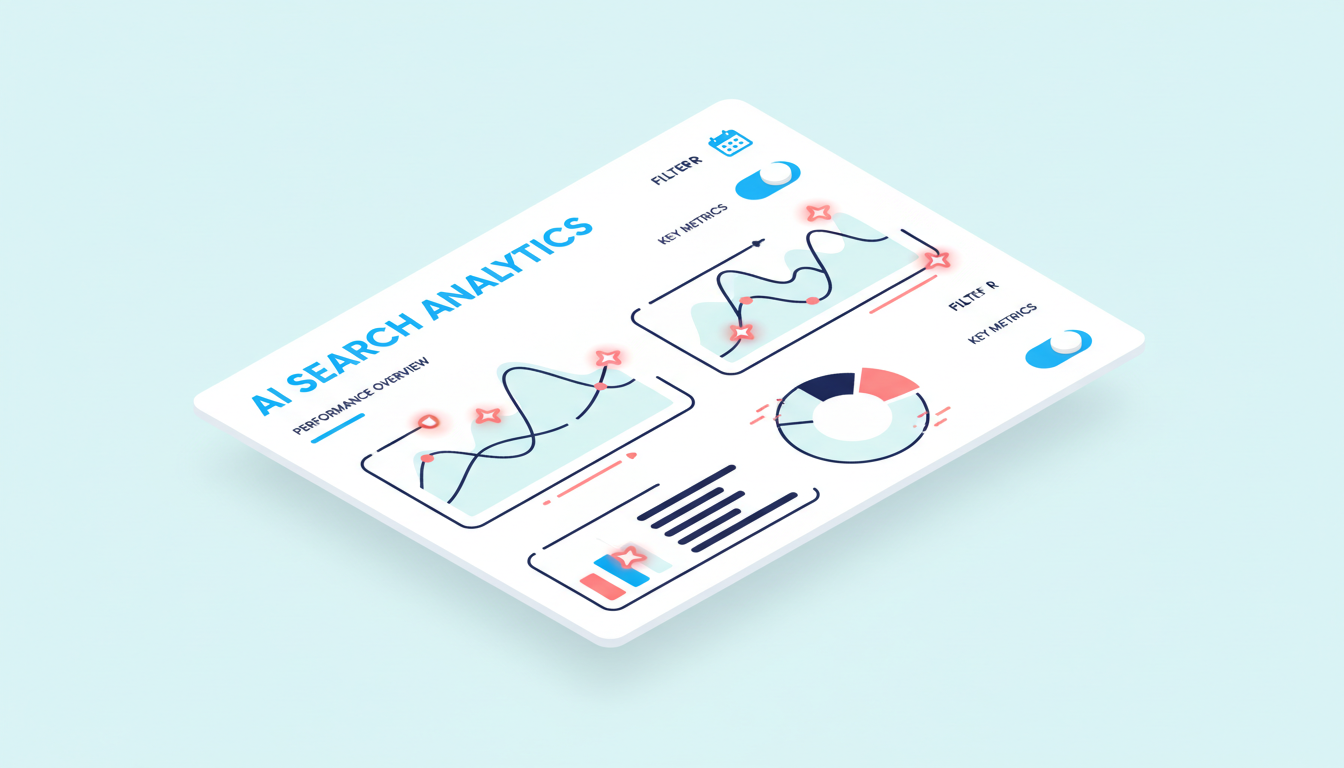
Launched in public preview on 11 February 2026, the AI Performance dashboard is the first official tool for measuring visibility in AI responses offered by a major search engine. It indicates which URLs of your site are cited, which queries trigger these citations, and how everything evolves over time.
Its true novelty lies in two indicators that did not exist in any public tool before.
Definition: grounding query
A grounding query is the internal query that the model formulates itself to go and fetch information on the web. When a user asks a long and confused question to Copilot, the AI breaks it down into several cleaner search phrases. It is these phrases, invisible to the user, that the report reveals.
The second indicator is the citation itself: the number of times a specific page of your site has served to construct a response. The shift in perspective is considerable. You are no longer optimising for what humans type, but for being retrievable on the formulations that an AI constructs in their place. This is a mental shift as profound as the move from keywords to topics in SEO classique.
The Four New Features of June 2026
On 16 June 2026, Microsoft announced on its blog the addition of four features to the report, deployed in global preview. They respond to the main criticism of the initial version: raw figures that are difficult to interpret.
Intents: Understanding the Intent Behind the Citation
The queries that trigger your citations are now classified into four categories: informational, commercial, navigational and educational. The value is direct: if you are cited on informational questions but virtually absent from commercial queries, you immediately know that you are missing bottom-of-funnel content — the kind that counts at the moment of the purchasing decision.
Topics: The Themes Where You Exist
This view groups your citations by main subjects, and shows the territories on which you are gaining visibility as well as those where you are absent. It is an editorial mapping tool: it reveals gaps in your thematic coverage far better than a classic keyword audit.
Citation Share: Finally a Relative Value
This is the most important new feature. Until now, the dashboard only displayed an absolute number of citations, without a point of comparison. The Citation Share now expresses your relative weight: if your site obtains three citations out of the ten associated with a given query, you display 30%. You move from a vanity statistic to a competitive indicator, comparable to a share of voice.
Compare: Putting Periods Side by Side
The comparison function allows you to confront periods or segments, and therefore to measure the real effect of a content overhaul. Without this component, it is impossible to say whether an optimisation produced anything at all.
The Four Features at a Glance
|
Feature |
What it delivers |
Concrete use |
|---|---|---|
|
Intents |
The intent behind each citation |
Identifying missing bottom-of-funnel content |
|
Topics |
Grouping by theme |
Mapping your editorial territories |
|
Citation Share |
A relative share, as a percentage |
Positioning yourself against competitors |
|
Compare |
Comparison of periods |
Measuring the impact of an optimisation |
Audit, setup and AI report analysis. We use Bing Webmaster Tools data to steer your visibility in generative search engines.
What These Reports Do Not Show
The enthusiasm deserves to be tempered, as the scope is narrower than it appears. The report covers Microsoft Copilot, Bing’s AI summaries and certain unnamed partner integrations. It does not cover ChatGPT, Perplexity, or Google’s AI Overviews. Any general conclusion drawn from these figures alone would therefore be excessive.
A second, more troublesome limitation: you cannot isolate Copilot from Bing summaries, nor know which partners are exploiting your content. The report aggregates different surfaces under a single total. Finally, the tool remains in preview, which Microsoft acknowledges: the data should be read as orders of magnitude, not as analytical accounting.
That said, a serious reason justifies taking an interest in it despite this scope. The content characteristics that trigger a citation in Copilot — clear structure, verifiable information, perceived authority — are largely the same as those that work elsewhere. For lack of equivalent data at Google and OpenAI, this report constitutes the best available signal for steering a GEO.
How to Use This Data in Practice?
Here is the method we apply on the accounts we monitor, once the site has been verified in the tool.
- Verify your site without delay: data does not backfill completely. The sooner you activate tracking, the sooner you have a usable history.
- Analyse grounding queries: they reveal the AI’s actual vocabulary on your market, often different from your target keywords.
- Cross-reference Intents and content: under-representation on commercial queries signals a lack of product pages, comparisons or case studies.
- Track Citation Share, not volume: a rising number of citations can mask a declining share of voice if the market is growing faster than you.
- Reinforce already-cited pages: a page that serves as a source has demonstrated its citability. Enriching it delivers more than creating a new one at random.
- Supplement with manual tests: query ChatGPT, Perplexity and Gemini on your strategic queries to cover the engines absent from the report.
Doko, Your Partner for Visibility in AI Search Engines
Doko is a human-scale Lyon-based webmarketing agency, based in La Mulatière. A Google Premier Partner, we support businesses on search engine optimisation in the AI era, combining available data and a rigorous method rather than intuition.
Configuring Bing Webmaster Tools, reading grounding queries, identifying content to transform into citable sources: this work requires as much analysis as editorial production. We work on real data and we adjust continuously, without promising miracles. Want to know if AI is already citing your site? Request a quote.
FAQ: The AI Reports in Bing Webmaster Tools
Is the AI Performance Report Free?
Yes. It is included in Bing Webmaster Tools, which is entirely free. You simply need to verify ownership of your site, as with Google Search Console, then consult the tab dedicated to AI performance.
Do These Reports Cover ChatGPT or Google?
No. The scope is limited to Microsoft Copilot, Bing’s AI summaries and certain partner integrations. Neither ChatGPT, nor Perplexity, nor Google’s AI Overviews are concerned. This is an essential limitation to keep in mind.
What is a Grounding Query, in Concrete Terms?
It is the query that the AI formulates for itself to go and fetch information. A user asks a question in natural language, the model reformulates it into several search phrases, and it is these phrases that the report exposes.
Should You Use Bing Webmaster Tools if Your Bing Traffic is Low?
Yes, precisely because of these reports. Even with little Bing traffic, the tool remains today the only official window into how an AI exploits your content, which no other player currently offers.
Do These Data Replace a Complete GEO Tracking Setup?
No, they complement it. The scope is partial and the tool still in preview. A serious strategy cross-references these figures with manual tests on other engines and classic editorial monitoring.