Will Content Quality Replace the Quantity of Backlinks in 2026?
It is one of the most persistent debates in organic search, and it returns with particular intensity since the arrival of answer engines. The reasoning seems logical: if Google and AIs value expertise and relevance, inbound links should no longer carry much weight.
The data tells a different story, more interesting than the announced duel. The question does not pit content against backlinks, as these two levers are not competitors: they are linked by a cause-and-effect relationship that the debate systematically obscures. However, a major shift has indeed taken place, and it concerns something else.
Here is what the figures say, what has really changed, and how to allocate your budget between the two.
Key takeaways from this article
- Backlinks remain among the most stable ranking signals in Google’s algorithm.
- 96.55% of pages with no organic traffic have no backlink pointing to them.
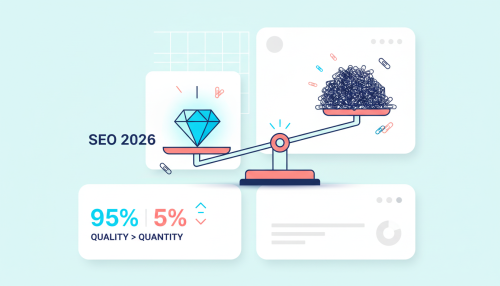
- The real shift does not pit content against links, but quality against quantity.
- Ranking without backlinks remains possible in low-competition niches.
- Editorial links also reinforce your citability in generative engines.
What the Data Really Says in 2026
Let us start by setting aside the hypothesis of disappearance. Google has modified hundreds of ranking parameters since the original PageRank, but backlinks have remained. Not out of conservatism, but because no substitute signal has reached the same resistance to manipulation. Google representatives confirm this regularly: the link remains an important signal, even if its relative weight has evolved.
Two figures are enough to frame the debate. On the one hand, according to Ahrefs, 96.55% of pages that receive no organic traffic have no inbound links. On the other hand, an analysis covering more than eleven million results shows that first-page pages have on average 3.8 times more backlinks than those ranked from second to tenth place. No serious study reveals a decorrelation between link authority and ranking.
Definition: backlink and referring domain
A backlink is a hyperlink from an external site pointing to one of your pages. The referring domain refers to the site of origin, regardless of the number of links it sends you. Ten links from the same domain carry far less weight than ten links from ten different domains: it is the number of referring domains, not the raw volume of links, that counts.
The Real Shift: Quality Has Replaced Quantity
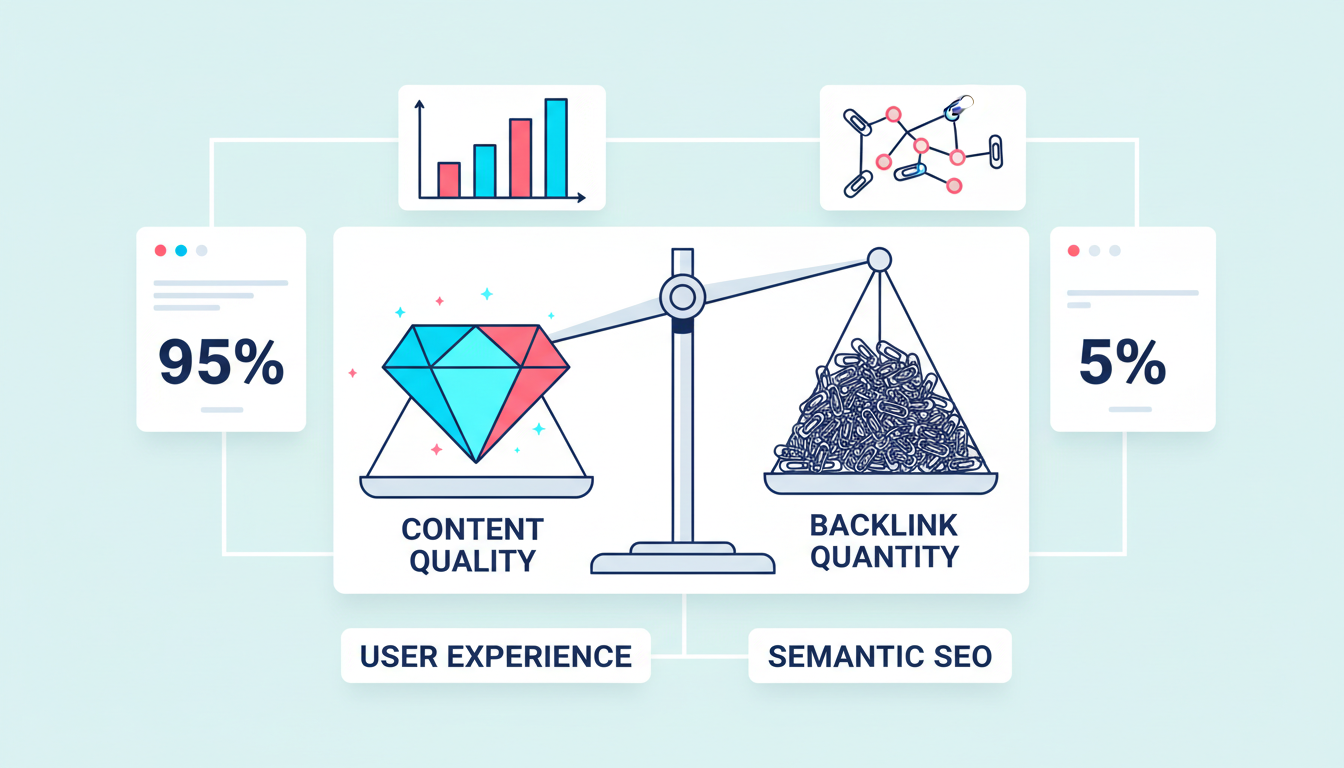
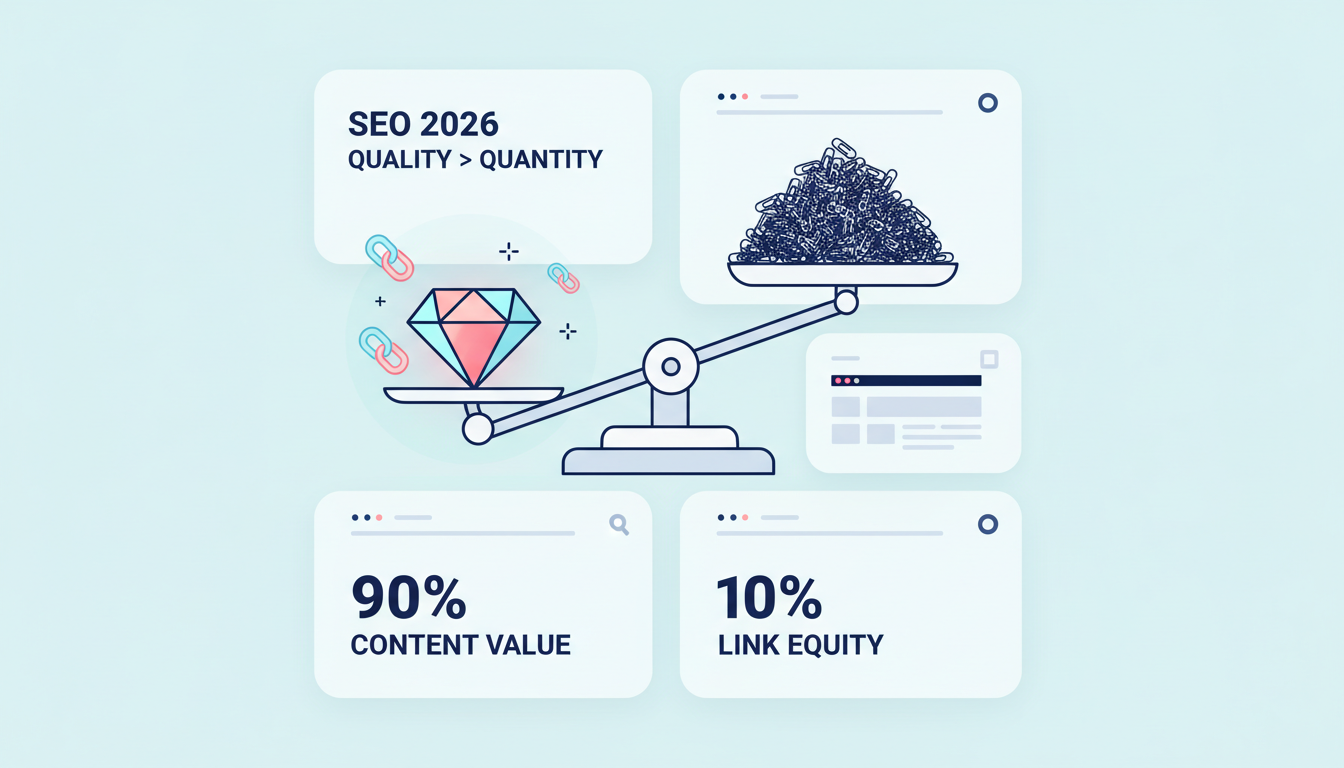
Here is the reformulation that clarifies the subject. It is not the quality of content that replaces the quantity of links, it is the quality of links that has replaced their quantity. The entry bar has risen considerably: a genuinely quality link is worth far more today than before the inflation of artificial networks, while a hundred links from outdated directories now produce no effect at all, when they do not trigger a penalty.
What Defines a Good Backlink
Thematic consistency comes first: a link from a site covering your field transmits infinitely more value than a mention on a generalist blog. Context comes next: a link naturally inserted into relevant editorial content has nothing comparable to a line in a page footer.
One criterion remains largely underestimated: the share of the referring site’s pages that actually receive traffic. A domain can display flattering authority while having 90% of its pages without a single visitor. This is the signature of a link farm, and the most effective filter for weeding out false good deals during a netlinking.
The Question of Anchor Text
L’link anchor, this clickable text, sends a powerful semantic signal, and this is precisely why over-optimisation is easily detected. A profile composed mainly of exact anchors on your target keywords appears artificial. A natural profile mixes brand, bare URL, generic expressions and a few optimised anchors.
The Case of Private Networks
A word of caution on PBNs, these private blog networks. Algorithmic detection has progressed markedly since 2023 on network footprints — same-class IP addresses, identical registrars, similar publication patterns. On a site you plan to operate for several years, the ratio between quick gain and risk incurred has deteriorated significantly.
What Distinguishes a Useful Link from a Useless One
|
Criterion |
High-value link |
Ineffective or risky link |
|---|---|---|
|
Thematic |
Close to your activity |
Off-topic generalist site |
|
Placement |
In editorial content |
Footer or sidebar |
|
Site traffic |
Pages actually visited |
Majority of pages without visitors |
|
Anchor |
Varied and contextual |
Exact keyword repeated |
|
Acquisition |
Editorial or natural |
Mass purchase, directories |
Audit, editorial strategy and quality link building. We build visibility based on what truly lasts.
Can You Rank Without Backlinks?
Yes, and it would be dishonest to claim otherwise in order to sell links. On under-exploited topics, where search intent is clear and no player dominates the results page, a well-structured and genuinely useful article can rank within a few weeks without a single inbound link. On this ground, relevance beats popularity.
The lever is then called thematic authority. A site that publishes thirty coherent and complementary pieces of content on a precise niche inspires more trust in Google than a generalist that barely touches the subject. This depth acts as a multiplier, even without netlinking. That said, the limit appears quickly: as soon as a query becomes competitive and commercially interesting, all your competitors are publishing good content, and the link once again becomes the differentiating factor.
Content and Backlinks: A Cause-and-Effect Relationship
The debate suffers from a blind spot: two levers are pitted against each other when one produces the other. The best backlinks are not bought, they are earned. An original study, a free tool, a reference infographic or a guide genuinely superior to what exists generates spontaneous links, without penalty risk and without an acquisition budget.
In other words, investing in content production is also a link strategy, on a delayed basis. Mediocre content never generates a natural link, which forces you to buy, and therefore to expose yourself. Framing the question in terms of content versus backlinks amounts to asking whether roots or branches are better.
The Unexpected Effect on Your AI Visibility
A recent argument reinforces the value of links, and it comes from unexpected territory. Generative models cite as priority the sources that Google already considers authoritative. On-the-ground observations converge: sites with a solid link profile are significantly better represented in the responses of ChatGPT, Perplexity or AI Overviews.
Links obtained from reference media and publications also contribute to establishing your brand as a recognised entity, which indirectly reinforces your citability. Netlinking therefore no longer serves ranking alone: it also feeds your visibility in generative engines. This makes the hypothesis of its disappearance rather unlikely.
How to Allocate Your Budget Between the Two?
Here are the principles we apply to distribute effort according to a site’s situation.
- Start with content and technique: acquiring links to a poorly structured or thin site is like filling a leaky bucket.
- Assess the competition on your queries: on a low-competition niche, content often suffices. On a coveted commercial query, links are the differentiating factor.
- Prioritise thematic fit over raw authority: ten relevant links in your sector are worth more than a thousand generalist links.
- Respect a natural velocity: a massive and sudden acquisition attracts the attention of algorithmic filters.
- Create assets that attract links: studies, tools, proprietary data. This is the only risk-free netlinking.
- Monitor your profile: un audit SEO audit allows you to identify inherited toxic links and anchor imbalances.
Doko, Your SEO Partner in Lyon
Doko is a human-scale Lyon-based webmarketing agency, based in La Mulatière. A Google Premier Partner, we build strategies where content and link acquisition reinforce each other, rather than selling one against the other.
Our approach always starts with an honest assessment: some sites need links, others must first correct their structure or publish content that deserves to be cited. We work on real data and we adjust continuously, without promising miracles. Want to know what is really blocking your visibility? Request a quote.
FAQ: Content and Backlinks
Are Backlinks Still Useful in 2026?
Yes. They remain among the most stable ranking signals in Google’s algorithm, and no serious study shows otherwise. What has changed is the quality requirement: low-value artificial links are now neutralised, or even penalised.
How Many Backlinks Are Needed to Rank?
There is no universal threshold. It all depends on the competition on your queries. The relevant indicator is not the volume of links but the number of quality referring domains, compared to that of sites already ranking in your market.
Is it Better to Invest in Content or in Links?
In content first, almost always. A thin site does not convert received authority, and good content generates natural links. Links become decisive once the foundation is solid and on genuinely competitive queries.
Does a Nofollow Link Have Value?
Google considers the nofollow attribute as a hint and not a strict directive. A nofollow link from a reference site brings visibility, traffic and brand awareness, all signals that count, even without direct transmission of popularity.
How to Identify a Toxic Backlink?
Watch out for off-topic sites, pages with no real traffic, over-optimised anchor profiles and platforms that sell links in bulk. Search Console and link analysis tools allow you to audit your profile and, if necessary, to disavow.