ChatGPT in 2026: Why GEO is Becoming Just as Important as SEO?
For years, online visibility came down to one question: how to appear at the top of Google? In 2026, this question is no longer sufficient. Hundreds of millions of people now ask their questions directly to ChatGPT, Perplexity or Gemini, and Google itself displays AI summaries above its results. Ranking well no longer guarantees being seen: you also need to be cited.
This is the whole challenge of GEO, Generative Engine Optimization. Far from replacing SEO, it is becoming its indispensable complement. Understanding why GEO is gaining momentum, and how to articulate it with your organic search, has become a marketing priority.
Here is what is changing, and how to adapt your visibility strategy.
Key takeaways from this article
- In 2026, a growing share of searches goes through ChatGPT, Gemini, Perplexity and Google’s AI Overviews.
- GEO optimises content to be cited as a source by these generative engines.
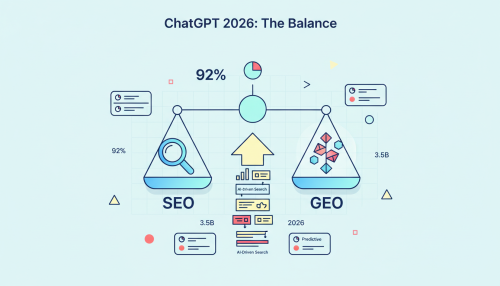
- SEO targets ranking, GEO targets citation: two complementary logics.
- SEO remains the foundation; GEO is the new strategic layer.
- Content structure, structured data, E-E-A-T and brand authority are at the heart of GEO.
What is GEO (Generative Engine Optimization)?
Le Generative Engine Optimization (GEO) refers to all the practices that make content visible and citable in the responses generated by generative engines: ChatGPT, Google Gemini, Perplexity, Claude, as well as Google’s AI Overviews. The objective is no longer simply to appear in a list of links, but to be integrated and cited at the heart of a response written by artificial intelligence.
Definition: GEO
GEO is the optimisation of content for answer engines based on language models. Whereas SEO seeks to position a page in search results, GEO seeks to make that page a source that AI selects, extracts and cites in its response. We move from a ranking logic to a recommendation logic.
Why GEO is Becoming Indispensable in 2026?
Usage has shifted. ChatGPT now exceeds 800 million weekly active users and processes several billion queries per day. On Google’s side, more than half of searches display an AI summary, and nearly 60% end without a single click towards an external site. The Gartner firm anticipates a drop of approximately 25% in traditional search traffic by the end of 2026.
We are leaving a search economy and entering a response economy. In this context, being visible in ChatGPT and other assistants is becoming a survival issue for many brands. Ignoring this shift means letting AI recommend your competitors in your place.
GEO and SEO: What is the Difference?
SEO: A Ranking Logic
Le organic search aims to position your pages as high as possible in search results, to generate clicks. It relies on keywords, solid technique, inbound links and quality content. It is a mature discipline, with well-established benchmarks.
GEO: A Citation Logic
GEO, on the other hand, does not seek the click but the citation. An article can be first on Google and yet invisible to AI, for example if it buries information under marketing paragraphs before answering. Generative engines reward structure and factual precision, not just authority.
Two Complementary Disciplines
Opposing SEO and GEO would be a mistake. A large proportion of sources cited in AI Overviews come from the organic top 10: SEO therefore remains the foundation. But AI also strongly values third-party mentions and brand authority, which SEO alone does not cover. The winning strategy in 2026 is hybrid: a robust SEO base, augmented with a GEO layer.
SEO and GEO at a Glance
|
Criterion |
SEO |
GEO |
|---|---|---|
|
Objective |
Ranking in the blue links |
Being cited as a source by AI |
|
Target |
Google search engine |
ChatGPT, Gemini, Perplexity, Claude, AI Overviews |
|
Key levers |
Keywords, inbound links, technique |
Citable content, structured data, brand authority |
|
Measurement |
Positions and clicks |
Citation share (Share of Voice) in AI responses |
Audit, ongoing SEO and GEO optimization. We turn your content into a source that AI engines select and recommend.

How to Implement a GEO Strategy?
GEO relies on solid fundamentals, often close to SEO best practices. Here are the priority workstreams.
- Structure content for citation: answer the question directly from the first lines, in autonomous blocks, with FAQs. Writing designed for extraction makes the difference.
- Strengthen structured data: Schema.org markup in JSON-LD helps AI understand and reuse your content, at the heart of on-site technical optimisation.
- Work on E-E-A-T and brand entity: expertise, authority and trustworthiness matter, as does your presence on the third-party sources that models consult.
- Keep content up to date: generative engines favour recent information; update your strategic pages regularly.
- Allow AI robots: check that GPTBot, ClaudeBot, PerplexityBot and OAI-SearchBot can access your site via the robots.txt file.
- Measure your share of voice: test your strategic queries on ChatGPT, Perplexity and Gemini to track your citations and identify gaps with your competitors.
Doko, Your SEO and GEO Partner in Lyon
Doko is a human-scale Lyon-based webmarketing agency, based in La Mulatière. A Google Premier Partner, we support businesses through the transition to a hybrid approach, where organic search and GEO reinforce each other. We measure your current presence in AI responses and identify the pages to transform into citable references.
Content structure, structured data, brand authority: we work on real data and we adjust continuously, without making promises of miracles. Want to stay visible in the era of ChatGPT and AI Overviews? Request a quote.

FAQ: GEO and SEO in 2026
Does GEO Replace SEO?
No. GEO complements SEO, it does not replace it. Organic search remains the foundation, notably because a large proportion of sources cited by AI comes from the best organic results. The right approach is hybrid.
How to Be Cited by ChatGPT or Perplexity?
By producing clear content, structured in direct answers, rich in structured data and backed by strong brand authority. AI robots must also be able to access your site.
Does GEO Only Apply to ChatGPT?
No. It targets all generative engines: ChatGPT, Gemini, Perplexity, Claude, as well as Google’s AI Overviews. People even speak of search everywhere optimization to also encompass YouTube, Reddit or social networks.
How to Measure Your Visibility in AI?
The most reliable method remains manually testing your target queries on the different engines, supplemented by citation tracking tools. Search Console and Google Analytics now integrate indicators linked to AI traffic.
Is SEO Dead in 2026?
No. SEO is not dead, it is becoming more demanding. Google itself points out that optimising for its AI Overviews amounts to doing good SEO. The fundamentals remain, the GEO layer is added on top.