🧩 Topic Clusters: Complete Definition and Guide to Building Your Semantic Cocoon

Two pages competing for the same keyword, a haphazard internal linking structure, a site stuck on page two. Topic clusters fix this structural problem: a central pillar page, surrounded by satellite pages that dig into each sub-topic, connected through coherent internal links.
This model, generally attributed to HubSpot around 2017, changes how Google understands and prioritises a site. It is often confused with the semantic cocoon, an earlier French method with a different logic.
The two look similar on paper, but they do not follow the same rules. Confusing them often leads to a shaky linking structure — neither a true cluster nor a true semantic cocoon.
Key takeaways
- A topic cluster pairs a pillar page with multiple satellite pages connected by internal links, to cover a topic in depth.
- The topic cluster (HubSpot) and the semantic cocoon (Laurent Bourrelly, 2007) are two distinct methods, not synonyms.
- The internal linking helps Google discover your pages, but no official source sets an ideal number of links.
- Each page targets a single keyword, to avoid keyword cannibalisation between your own content.
- A cluster’s success is measured through rankings, organic traffic, and for Doko, on the conversions generated.
📖 What Is a Topic Cluster in SEO?
A topic cluster rests on a central page — the pillar page — surrounded by satellite pages that deepen related sub-topics. Each satellite page points to the pillar page, which in turn links back to its satellites. This structure helps Google map your coverage of a topic, page by page.
🔗 Definition and How It Works (The Hub & Spoke Model)
Definition: A topic cluster (or Hub & Spoke model) refers to a central pillar page connected by internal links to a set of satellite pages, each addressing a specific sub-topic of the same subject.
The term is generally attributed to HubSpot, which popularised this model around 2017 under the name “topic clusters” or “hub and spoke model”. The pillar page covers the topic broadly; satellite pages dig into a specific point and link back to it with relevant anchor text.
The structure works in both directions: the pillar page gains authority through inbound links from its satellites, and the satellites inherit its visibility. Doko structures its content strategies around this logic for the majority of its B2B clients.
⚖️ What Is the Difference Between a Topic Cluster and a Semantic Cocoon?
Confusion is common in French-speaking SEO, but the two methods share neither the same origin nor the same logic. The topic cluster comes from the United States and rests on a flexible structure centred on a pillar page.
The semantic cocoon, on the other hand, is a French method, formalised by Laurent Bourrelly in 2007, organised into strict descending silos. Bourrelly presents himself as “the creator of the strategy”, a concept he “formalised in 2007”.
| Criterion | Topic cluster | Semantic cocoon |
|---|---|---|
| Origin | HubSpot (United States), around 2017 | Laurent Bourrelly (France), 2007 |
| Structure | Pillar page + satellite pages | Strict silos, descending hierarchy |
| Internal links | Bidirectional, flexible | Descending, few cross-links |
| Objective | Cover a topic broadly and in depth | Concentrate link power towards target pages |
| Flexibility | High, evolving structure | Low, structure fixed from the outset |
Doko’s view: We recommend the topic cluster to the majority of our clients, because its flexibility adapts better to sites that evolve quickly. The semantic cocoon retains its value on projects with a fixed scope.
Pillar pages, supporting content, keyword research and internal linking: learn how to build effective topic clusters to strengthen visibility and generate more conversions.

🚀 Why Topic Clusters Are Essential for Your SEO
Once the distinction is clear, the question that matters for your traffic remains: why invest time in this structure? A well-built topic cluster acts on three levels: the technical understanding of your site by Google, the internal distribution of authority, and genuine user satisfaction.
🤖 Improving How Google Crawlers Understand Your Site
Google discovers most pages by following links on those already crawled. Without coherent internal linking between a pillar page and its satellites, some pages remain difficult to find, even if well written.
Anchor text also plays a direct role: it tells both crawlers and users what the linked page contains. A well-linked cluster helps Google understand the thematic scope covered by your site.
⚡ Boosting Internal PageRank Through Internal Linking
PageRank remains a concept used internally by Google’s algorithm to assess the relative authority of pages on a site. But the public Toolbar PageRank, which displayed a visible score from 0 to 10, was discontinued in 2016: no score is therefore consultable today, contrary to what some SEO content would suggest.
The image of “SEO juice” flowing between pages remains useful to visualise the principle, without being a technical synonym for PageRank. Each internal link to the pillar page from a satellite strengthens its relative authority.
🎯 Perfectly Answering User Intent and Establishing Authority
A complete cluster covers a topic from every useful angle, matching what a user is looking for when exploring a theme in depth. This broad coverage is consistent with Google’s E-E-A-T criteria (experience, expertise, authority, trustworthiness).
This connection remains an interpretation, popularised in particular by HubSpot — not an official algorithmic declaration from Google. In practice, a site that covers a topic with several well-built satellites appears more authoritative than one with a single superficial page.
Doko’s view: In the audits we conduct, the sites that gain lasting visibility are almost always those that have structured their content in clusters, not those that publish isolated articles with no links between them.
🛠️ How to Create a High-Performing Topic Cluster (Step by Step)
Understanding the value of the model is one thing; building it is another. The method unfolds in four steps, from defining the central topic to publishing the satellite pages:
- Define your central topic and audit existing content.
- Conduct thorough keyword research.
- Structure the pillar page.
- Write and link the satellite pages.
1️⃣ Step 1: Define Your Central Topic and Audit Existing Content
Before creating anything, list the topics already covered on your site and identify pages that can serve as a pillar page. A content audit often reveals existing pages to strengthen rather than starting from scratch.
Choose a theme broad enough to justify several sub-topics, but precise enough to remain relevant to your business.
2️⃣ Step 2: Conduct Thorough Keyword Research
Identify the main keyword for the pillar page, then list the associated questions and variants that will become satellite pages. Search Console and keyword research tools help identify the search intents genuinely associated with the topic.
Each sub-topic must correspond to a distinct intent, otherwise two satellite pages risk cannibalising each other.
3️⃣ Step 3: Structure the Pillar Page (Hub Page)
The pillar page covers the topic broadly, without going into the detail that satellite pages will address. It includes links to each satellite existing or planned, with clear anchor text.
Its structure (headings, table of contents, sections) must reflect all the sub-topics of the cluster, like a living table of contents.
4️⃣ Step 4: Write and Link the Satellite Pages (Spokes)
The number of satellite pages varies according to the breadth of the topic and available content resources. HubSpot, the originator of the model, mentions a range of up to 20 or 30 satellite articles for a complete cluster; tighter clusters also exist, focused on the most searched sub-topics.
Rather than targeting a precise number, it is better to cover each sub-topic that has genuine search demand behind it. Each satellite page links back to the pillar page, and ideally to the other relevant satellites.
Doko’s view: Our method consists of mapping the entire cluster before writing a single line, including the pillar. This avoids publishing satellites that overlap or forget to link to the right page.
⚠️ Common Mistakes to Avoid When Building Your Clusters
Following the method to the letter does not prevent missteps. A poorly executed cluster can do more harm than good. Here are the three most common mistakes we observe on audited sites.
🕸️ Neglecting Internal Linking or Creating Artificial Links
A pillar page with no link to its satellites, or links forced into place in off-topic sentences, break the value of the cluster. Linking must remain natural, with anchor text that reflects the content of the linked page.
Note: a forced internal link, unrelated to the sentence context, harms the reading experience as much as the signal sent to Google.
🥊 Keyword Cannibalisation: When Pages Compete with Each Other
When two pages on your site target the same keyword and the same search intent, they compete with each other in Google results, often to the detriment of both. The rule to remember: a unique target keyword per page.
Before publishing a new satellite page, check that no existing page already addresses the same intent. Regular audits help identify these duplicates before they weigh down your rankings.
🕰️ Forgetting to Update Content Over Time
A topic cluster is never static. Sub-topics evolve, new questions emerge, and a pillar page published two years ago may no longer reflect the state of the subject.
Regularly reviewing the cluster’s pages, adding satellites when a new sub-topic warrants it, and fixing broken links are part of the normal upkeep of a SEO content strategy.
Doko’s view: We systematically include a cluster review in our annual content plans. A cluster that no longer evolves loses its position against competitors who keep publishing.
📊 How to Measure the Success of Your Topic Clusters
Once the cluster is published and the pitfalls avoided, one question remains: does all this work pay off? Performance is read at two levels — classic SEO metrics, and for Doko, the real business impact generated by the strategy.
📈 SEO KPIs to Track (Rankings, Organic Traffic)
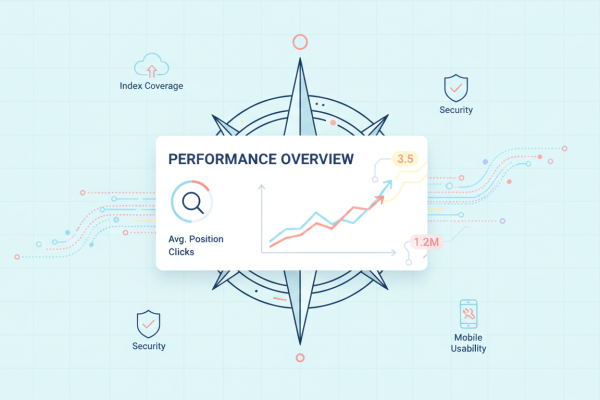
Standard tracking rests on average cluster rankings on its target keywords, organic traffic to the pillar page and its satellites, and the “Performance” report in Google Search Console pour visualiser l’évolution clic par clic.
Compare these metrics before and after the cluster is set up, over a period long enough to smooth out the natural variations of the algorithm.
💼 Tracking the Impact on Conversion and Lead Generation (Doko’s Objective)
Rankings and traffic alone are not enough to justify a content investment. Doko systematically tracks the conversion rate per page of the cluster, as well as the leads generated from the pillar page and each satellite.
This business reading identifies which satellite pages deserve to be strengthened first, and which serve mainly for linking without generating direct conversion. Want to know whether your content strategy is genuinely generating customers, not just traffic? The Doko team can audit your existing cluster and identify the pages to work on first.
Doko’s view: Our stance: a cluster that does not convert must be reworked, not abandoned. The problem rarely lies with the topic — more often with the pillar page or the conversion path offered to the reader.

❓ FAQ — Everything You Need to Know About Topic Clusters
🔀 What Is the Difference Between a Topic Cluster and a Semantic Cocoon?
The topic cluster (HubSpot, flexible structure around a pillar page) and the semantic cocoon (Laurent Bourrelly, strict descending silos) are two different methods — not two names for the same thing.
🔢 How Many Satellite Pages Does a Topic Cluster Need?
There is no universal number. Some methodologies, including the model’s original source, go up to 20 or 30 satellite pages; the key is to cover every sub-topic that has genuine search demand.
💰 Do Topic Clusters Help with Conversion?
Indirectly, yes: a well-built cluster brings more qualified traffic to your pages. Doko recommends tracking the conversion rate per page to verify that this traffic genuinely turns into leads.
🚫 How to Avoid Keyword Cannibalisation in a Cluster?
By assigning a unique target keyword to each page in the cluster, and checking, before each publication, that no existing page already addresses the same search intent.
💡 What Is a Topic Cluster, in One Sentence?
It is a pillar page connected by internal links to multiple satellite pages, each deepening a sub-topic of the same subject — a method Doko uses to structure its topic cluster strategies.
📚 Sources
Source: https://developers.google.com/search/docs/fundamentals/seo-starter-guide
Source: https://en.wikipedia.org/wiki/PageRank
Source: https://blog.hubspot.com/marketing/topic-clusters-seo
Source: http://web.archive.org/web/20190327183616/http://www.laurentbourrelly.com/blog/categorie/cocon-semantique