SEM, SEO, SEA: What Are the Differences and How Do You Combine Them?
SEM, SEO, SEA: three acronyms that look alike, and a confusion that comes up in almost every marketing meeting. A client asks for a SEM strategy, one agency sells SEO, another sells SEA. At bottom, nobody is talking about the same thing.
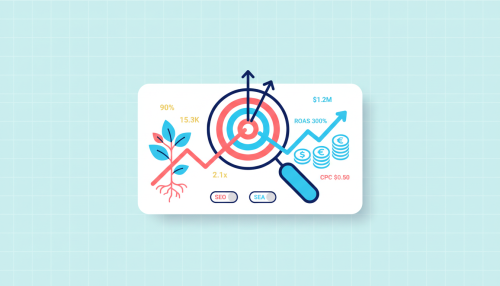
Here is the formula to remember: SEM encompasses SEO and SEA. The first is the umbrella term, the other two are its components — one organic, the other paid. Once this triptych is established, choosing your strategy becomes simpler.
Key takeaways
- SEM (Search Engine Marketing) encompasses SEO and SEA.
- SEO produces organic traffic without paying per click, but takes time.
- SEA relies on bidding and pay-per-click (CPC), with immediate results.
- SEO and SEA are complementary: they share keyword data and occupy more space in search results pages.
- The choice depends on the objective: speed for SEA, sustainability for SEO.
Understanding the Digital Marketing Triptych (Definitions)
Before comparing SEO and SEA, let us set the definitions straight — this is where most misunderstandings arise.
What Is SEM (Search Engine Marketing)? The Umbrella Term
Definition: SEM (Search Engine Marketing) refers to the marketing actions carried out on search engines to improve a site’s visibility, whether organic or paid. In French, the reference definition establishes the equation SEM = SEO + SEA.
One more point to note: English Wikipedia and publications such as Search Engine Journal often use “SEM” as a synonym for the paid side only, setting it against SEO rather than encompassing it. This article uses the French definition, which is more coherent for a global strategy.
What Is SEO (Search Engine Optimization)? Organic Traffic
Definition: SEO, or organic search, encompasses the techniques that help search engines understand a site’s content in order to position it in organic results. Google Search Central summarises the objective as: helping engines understand the content, and users decide whether to visit it.
No payment is made to Google to obtain an SEO ranking. The position is earned through content quality, the site’s technical structure and the links acquired.
What Is SEA (Search Engine Advertising)? Paid Search
Definition: SEA, or paid search, refers to sponsored links that appear in search results through a bidding system, on Google Ads. The advertiser targets keywords and pays per click (CPC), not per impression.
In France, SEA accounted for €3.698 billion in advertising investment in 2022, representing 44% of digital advertising spend, according to the SRI/Udecam observatory.
SEO vs SEA vs SEM: Comparative Table of Key Differences
The difference between SEO and SEA can be summarised in a few criteria.
|
Criterion |
SEO (organic search) |
SEA (paid search) |
|---|---|---|
|
Payment model |
No payment to the search engine |
Pay-per-click (CPC) |
|
Speed of results |
Slow, several weeks to months |
Immediate, from launch |
|
Durability |
Durable traffic once ranking is achieved |
Stops when the budget runs out |
|
Message control |
Limited by the search engine algorithm |
Full control of ad copy |
|
Positioning |
Organic results |
Sponsored results, often at the top of the page |
SEM deploys both levers according to objectives and available budget.
SEO for sustainable organic traffic, SEA for immediate results: learn how to combine both channels to maximize visibility and conversions.
Why and How to Combine SEO and SEA in Your SEM Strategy
Pitting SEO against SEA makes little sense: the two channels feed each other in a well-constructed SEM strategy.
The Advantages of the Hybrid Approach (SEO + SEA)
Combining SEO and SEA offers two concrete advantages, observed while managing client accounts. The first is data sharing: keywords that convert well in SEA help prioritise SEO content, and vice versa. The second relates to visibility: holding a sponsored result and an organic result for the same query reinforces brand presence.
Note : no reliable quantitative data allows a precise click gain to be attributed to this combination. The benefit remains qualitative, but we observe it with clients who run both channels in parallel.
When Should You Prioritise SEA?
SEA comes into its own when speed is the priority: launching a new product, a time-limited offer, or testing keywords before investing in SEO content. It also offers full control over the ad message.
When Should You Play the Long Game with SEO?
SEO becomes profitable for building durable organic traffic, without depending on a permanent advertising budget. Once the ranking is achieved, traffic keeps coming without a cost per click. It is a choice that pays off over time, provided you are patient at the start.
At Doko, this hybrid logic guides every SEM strategy built with our clients: SEA to kick-start and test, SEO to establish lasting visibility. If you are unsure about the right allocation, a review of your situation often brings clarity.
How to Measure the Success of Your SEM Strategy
Each channel has its own metrics. Confusing them distorts performance analysis.
Essential SEO KPIs
In Search Console, the key metrics are impressions, average position, clicks, click-through rate (CTR, i.e. clicks divided by impressions) and conversions generated by organic traffic.
Key Performance Indicators in SEA
On the SEA side, we track maximum and actual CPC, CTR, cost per acquisition (CPA), ROAS (return on ad spend) and conversion rate.
Note : contrary to a widespread misconception, the Quality Score is not a direct bidding criterion. Google Ads describes it as a diagnostic tool that benchmarks ad quality against other advertisers, based on expected CTR, ad relevance and landing page experience.
FAQ: Everything You Need to Know About SEM, SEO and SEA
What Is SEM?
SEM (Search Engine Marketing) encompasses all search engine marketing actions, organic and paid. In short, SEM = SEO + SEA, even if English-language usage sometimes reduces the term to the paid side alone.
What Is the Difference Between SEO and SEA?
SEO generates organic traffic without paying per click, but takes time. SEA relies on bidding and pay-per-click, with immediate visibility that stops as soon as the budget is exhausted.
Should You Choose SEO or SEA?
It is not a binary choice. The decision depends on the objective: SEA for quick visibility, SEO for durable traffic. Most SEM strategies combine both.
Is SEO Free?
Not quite: no payment per click or to the search engine is required, but SEO demands a real investment in time, skills or agency support.
How Do You Start an SEM Strategy?
Here are the main steps for laying the foundations of an SEM strategy:
- Define clear objectives (awareness, conversion, product launch).
- Identify priority keywords for SEO and SEA.
- Allocate the budget between SEO and SEA according to the urgency of results.
- Launch the first actions (SEO content, SEA campaigns).
- Measure results using each channel’s KPIs.
Sources
Source: https://developers.google.com/search/docs/fundamentals/seo-starter-guide
Source: https://support.google.com/webmasters/answer/7042828
Source: https://support.google.com/google-ads/answer/2459326
Source: https://support.google.com/google-ads/answer/6167118
Source: https://www.definitions-marketing.com/definition/sea/